

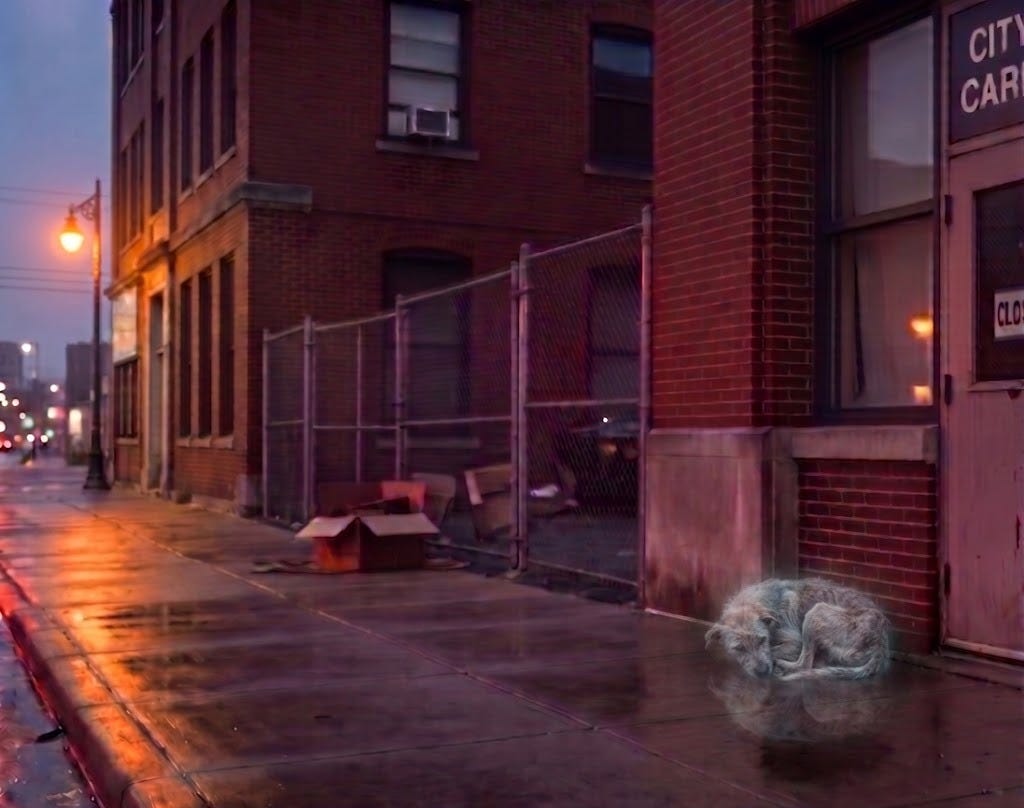
Shelter (ˈshel-tər): an establishment providing food, protection from danger, and temporary housing for stray or unwanted animals.
In my recent article, “Lies, Damn Lies & Best Friends Animal Society,” I made the case that shelter policies and statistics touted by Best Friends about the number of No Kill communities and the 2025 decline in national rates of killing are dishonest. Specifically, I argued that the data was not reliable and, more importantly, ignores the increasing number of municipal “shelters” and those with municipal contracts turning their backs on animals by restricting admission, even for strays.
I received a number of responses from rescuers, advocates, and shelter directors about their own experiences scrambling to help animals and to counter the false narrative of success after local municipal pounds closed their doors to animals in need. These pandemic-era closures continue in many communities at the urging, or with the blessing, of groups like Best Friends and others, including consultant and pound apologist Kristen Hassen who helped create the policy: Human Animal Support Services (HASS).
Under HASS — euphemistically referred to as “community sheltering” or “managed intake” — municipal pounds stop taking in strays (and often owner surrenders), telling people to handle the animals themselves, turn them loose, or leave them on the sidewalk. This puts the onus on residents to do the job they already pay shelters to do through their tax dollars. It also puts animals in harm’s way and ignores their right to rescue.
As Austin Pets Alive (APA), one of the primary architects of the policy, initially stated: “Intake of healthy strays and owner surrenders doesn’t exist anymore,” and there is “No kennel space for rehoming, stray hold or intake.” APA urged communities to permanently implement this before the pandemic ended and the public demanded a resumption of services.
But the backlash was more significant than proponents anticipated and they changed the strategy to sell it. They began claiming that “managed intake” is simply the how and when of admissions, focusing on scheduling non-urgent cases to better allocate resources, and creating “pet help services” to keep animals in homes. In practice, however, nothing changed. “Community sheltering” still too often means “no entry.”
In some communities, staff tell people who find strays that they have to make an appointment — which can be months out. In the more regressive communities, staff tell Good Samaritans to let the animals go where they found them. This is not just abandonment of the core mission, it is animal abandonment.
A false choice
As I explained in the article, “the silver lining here, to the extent there is one, is that if ‘shelters’ aren’t taking them in, they aren’t killing them. But turning them away or taking them in and putting them to death are not the only two options.” The No Kill Equation’s success at ending the killing of healthy and treatable animals in open admission shelters eliminates the false choice.
Open admission No Kill Equation communities are achieving 98%-99% placement rates. By contrast, annual intake dropped in the HASS communities by leaving animals on the street — in some cases by as much as 50%. But those animals don’t disappear. They are just rendered invisible. This includes malnourished and injured animals eating trash to survive. It includes those who have died from hypothermia, starvation, or being hit by a car.
And it is not just animals who suffer. Stray dogs are much more common and people are trying to catch them without any support. Not surprisingly, bite numbers have increased. It is only a matter of time before more people get hurt, there is a backlash, and reactionary voices begin calling for draconian measures against scared and traumatized dogs.
A dishonest rationale
The justification for turning away animals is a 2019 survey at Dallas Animal Services. The survey of healthy strays who were subsequently reclaimed by their families determined that 70% of the dogs were within one mile of their home. Although more than half the stray dogs were not reclaimed, and therefore the proximity to their homes (or if they even had homes) remained unknown, “shelters” are using the survey to justify leaving all animals on the street.
The No Kill Advocacy Center subsequently did its own analysis, using multiple communities. That analysis showed that dogs were found, on average, two miles (1.96 miles) from home, with one shelter’s average being 3.2 miles. And while many dogs were within one mile of their home, the Dallas survey only showed where the dogs were found. It did not show where they were going.
By contrast, The No Kill Advocacy Center data demonstrated that the longer dogs are missing, the farther away from their homes they tend to be found, upwards of 4 to 5 miles. Moreover, one mile is still very far and very foreign for a dog. That is 10-14 blocks away from home depending on the neighborhood. And some blocks are more dangerous than others, such as traffic risk. Yet, under HASS, “shelters” treat all these dogs the same.
Regardless of how far from their homes they are, proponents do not know if the dogs will find their way back without intervention. In fact, Ellen Jefferson of Austin Pets Alive, who helped craft HASS, admitted that “There is just an unknown number of animals that are falling through the cracks out there in the community and we just don’t have a really good understanding of how many that is…” That hasn’t stopped her from promoting the policy anyway.
It also has not stopped her from ignoring that good outcomes for lost dogs are not achieved by doing nothing, but by more robust and targeted intervention: having animal control officers knock on doors in the neighborhood, scanning for microchips in the field, and returning them home when they discover where home is, rather than impounding them into the shelter.
The Dallas survey also ignores the animals who do not have homes, have no family looking for them, and may stay homeless without a shelter to rehome them. For them, and many of the others, the results can be devastating. But once again, animals are not the only victims. Although the local municipal pound still gets funded for a job they refuse to do, individuals and rescue groups are struggling to help at their own expense. While these volunteers are burning out and going broke, national groups are declaring “victory” because the “save rate” looks higher on paper.
A corrupt benchmark
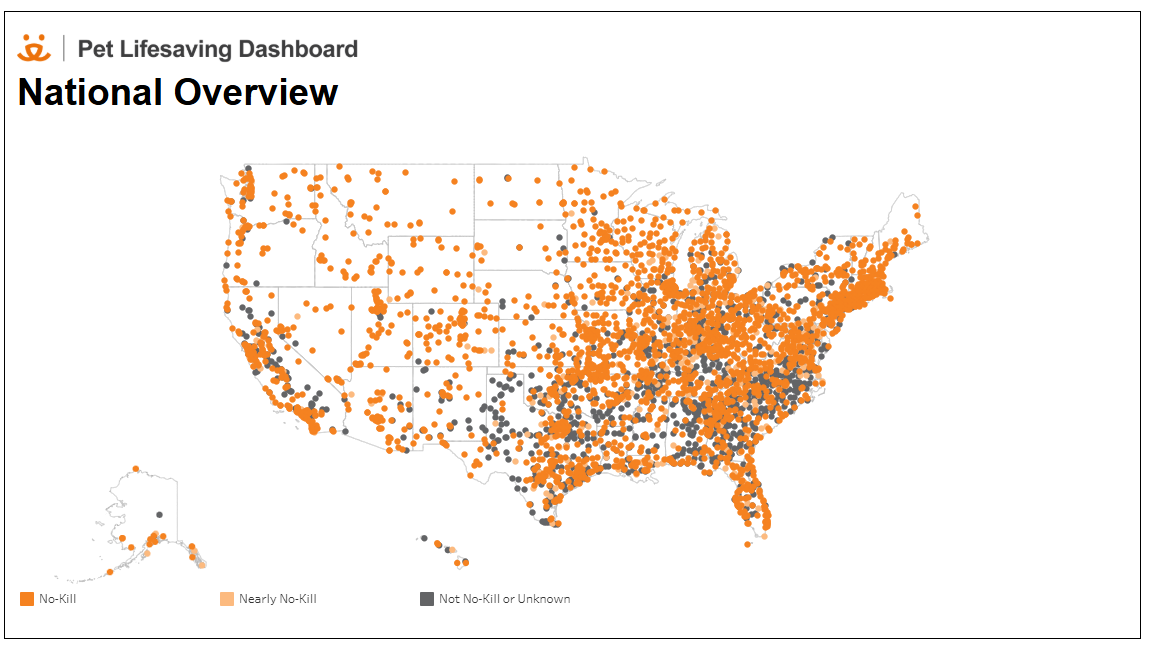
The “orange dot” is the symbol used by Best Friends on its online dashboard to mark a community that they claim has reached a 90% placement rate. As I have reported elsewhere, while Best Friends continues to make the claim that “shelters” can kill up to 10% and still be considered No Kill, that argument does not withstand scrutiny. The guideline that about 10% of animals are irremediably suffering was promulgated in 2008 with a minimal data set — less than a handful of communities with placement rates between 92% and 95% — and when many illnesses, like parvovirus, had a poor to grave prognosis for recovery. Even then, placement rates exceeded 90%.
Today, these once-fatal diseases have a good to excellent prognosis. Additionally, understanding of and the ability of shelters to rehabilitate dogs once considered “aggressive” has vastly improved. As a result, communities across the country are successfully placing 98%-99% of animals. By current veterinary standards, roughly 1% of animals entering shelters are dangerous dogs and irremediably suffering animals.
That issue notwithstanding and setting aside the fact that many of these communities also manipulate data — by excluding “owner requested killing” and “deaths in kennel” and providing a combined rate to hide mass killing of cats — the orange dot ignores the fact that most at-risk animals are barred from entering the “shelter.” As such, it erases the thousands of ghost dogs and ghost cats left on the streets.
If achieving a No Kill nation is to have meaning, we must remain grounded in the truth: a placement rate is dishonest if it is achieved through abandonment of the very animals “shelter” staff have a duty to protect. These animals don’t disappear just because Best Friends, Kristen Hassen, and their acolytes running municipal pounds are not counting them.
They are still suffering. They are still dying. And they still matter.
Dear Nathan, Thank you for using your legal expertise and wisdom to expose the hypocrisy and lies of Best Friends Animal Society, Austin Pets Alive, Kristen Hassen and HASS, and those political leaders and others
who don’t save the voiceless “ghost “ dogs and cats that are left on the streets. What has happened to “humanity “ that /who allows Sentient Beings/Animals to be treated as “things " rather than as living beings who deserve better?! Animal SHELTERS should be doing what they are designed to be doing, that is, to feed, protect, and find loving homes for strays and lost or abandoned pets. BE TRUTHFUL .== EACH AND EVERY LIFE MATTERS ❤️🐶😸🐇
So, when I have to find a rescue to take a dog because the shelters put a long delay into when the dog can get in to a shelter, that the owner is stuck as to what to do, that I as a senior citizen stopped everything for a day and a half to make sure this got expedited.
You are damn right the shelter work gets put on people outside of the shelter system.
But at least I knew the realities I am up against, so that I actually did this for a young couple I did not know.
Thanks for calling these abuses out.