

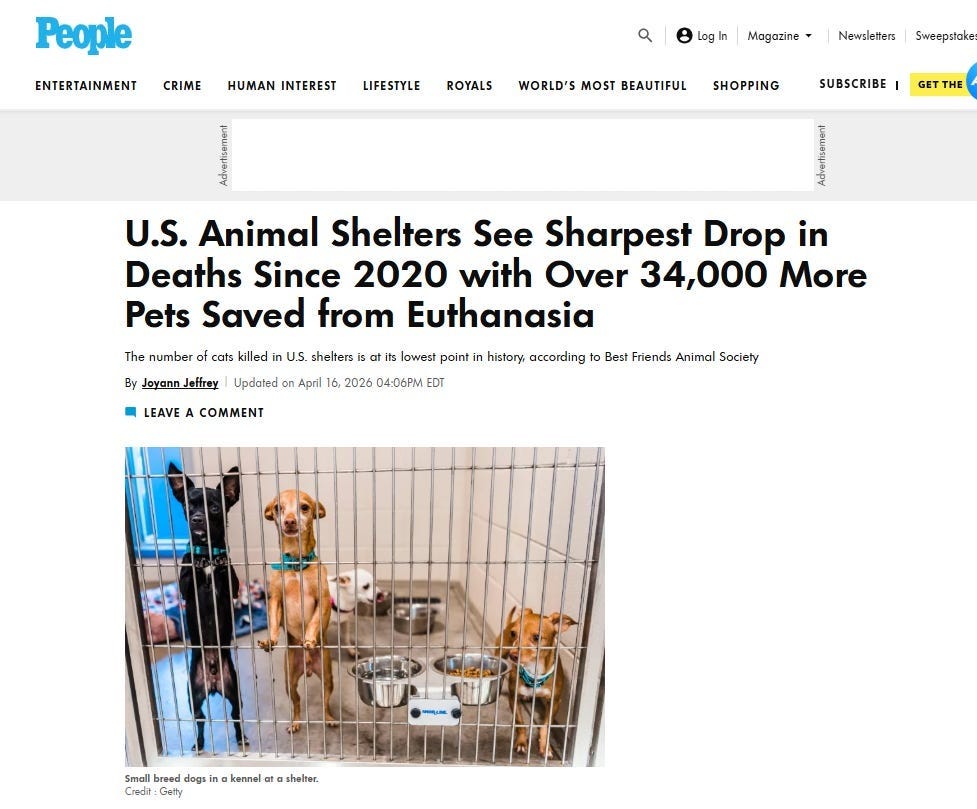
There are those who never let the facts get in the way of a good story. Then there is Best Friends Animal Society. Best Friends never lets the facts get in the way of fundraising. No false claim is too big or too small if it means more money in their already bloated coffers.
The latest? Best Friends says that the number of dogs and cats killed in U.S. pounds dropped by 34,000 in 2025 compared to 2024. They also say that the number of dogs killed in shelters decreased by almost 10% and a record-high 83% of cats were saved.
Of course, “saved” is quite the wrong word. If an animal has been hit by a car or is suffering from a serious disease and given veterinary assistance that prevents death, that animal has been saved by a shelter. Likewise, when a rescue organization takes an animal from death row at a pound, that animal has been saved because the rescuer intervened to prevent the animal from being killed by someone else. But when the term “saved” is used to describe a pound choosing to adopt out instead of killing that animal, killing is implied to be a natural outcome of animal homelessness that must be overcome, which it is not.
Homelessness is not a fatal condition — or at least it shouldn’t be. Moreover, most animals who enter pounds are healthy and treatable and not in danger of dying, but for the threat the pound poses. Pound employees cannot accurately be described as having “saved” an animal when the only threat the animal faced was the one that they themselves presented. In short, if someone was threatening to kill you and chose to let you live instead, would you describe that person’s actions as having “saved” you?
Semantics aside, no one wants the decline in killing to be true more than me. I’ve worked the bulk of my adult life on this. But it isn’t true. Best Friends is making claims about national kill rates based on fewer than 20% of reporting “shelters.” As previously reported, they used only 688 of the approximately 4,915 brick-and-mortar U.S. shelters (14%) in 2024 to project nationwide killing rates and numbers. The worse the pound, the less likely they are to report. Consequently, the nationwide numbers will be much worse.
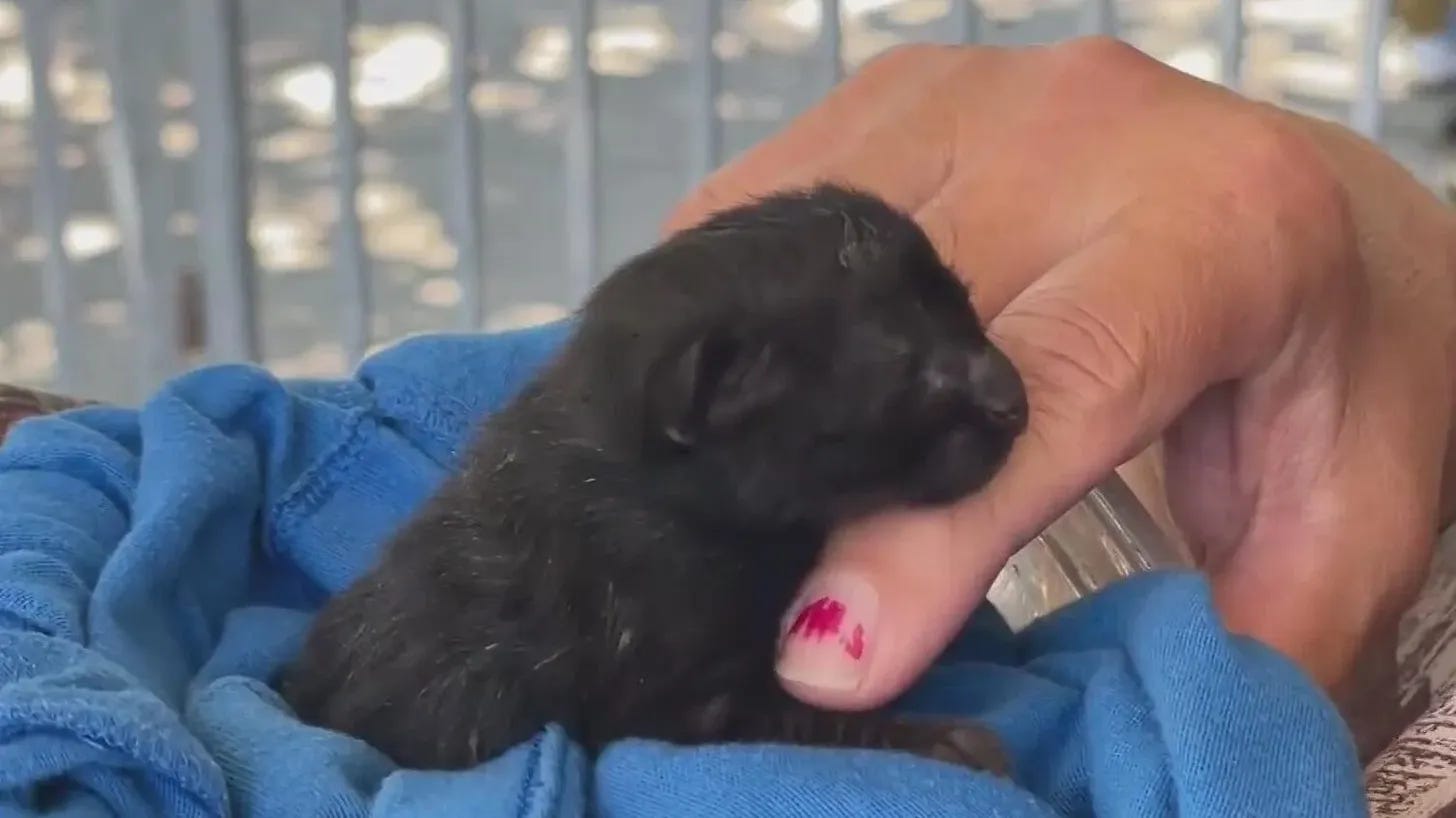
Some of these facilities turn away orphaned neonatal kittens. They don’t answer the telephone, rarely return calls, and will not send staff to assist rescuers and animals. They make it difficult to adopt, often requiring appointments, even though appointments markedly reduce the number of animals who find homes. They no longer publish statistics or only provide opaque “save rates” that ignore animals they turn away, remove whole categories of animals who lose their lives (like “owner requested killing” or “deaths in kennel”), combine species to hide mass killing of cats, and use a 90% metric that still allows healthy and treatable animals to be killed. Best Friends pretends some of these facilities — neglectful, abusive, murderous — are No Kill. Case in point: “shelters” that Best Friends deemed “No Kill” killed roughly half a million animals in 2024, according to their own data.
As such, the real cost in animal lives in both these pounds and the 86% that didn’t report statistics is substantially higher. Indeed, more robust data sets paint a more sobering picture. Despite a decline in intakes, “shelters” did not capitalize on the opportunity.
For dogs, shelters failed to increase adoptions, while return-to-owner rates declined. Although the number of dogs killed remained roughly the same, the number they allowed to die in their kennels increased by a shocking 11%. Because many shelters exclude these animals from statistics to conceal poor performance, there is a cruel and perverse incentive to allow them to die.
Cats fared poorly, too. Cat killing increased by 2.5%, despite no increase in intakes, and the number dying in their kennels also substantially increased by 8%. Deaths in kennel should never top 1% of all intakes.
And that doesn’t include animals, like those in Pickens County, AL, where there is no “shelter” and residents and even police simply shoot the dogs. According to Aubrie Kavanaugh, who founded No Kill Huntsville, “Every Alabama county is required to have a ‘pound.’ Of 67 counties, 37 have a pound and animal control, 13 have a pound but no animal control, 1 has animal control and no pound and 16 have no services at all.” Roughly half are not meeting even minimal obligations. Of those counties that have a pound, the vast majority engage in population control killing.
Even university professors that do research in this area called on groups, like Best Friends, to stop misleading people with animal welfare metrics that hide what they called “rural disparities.” But they are wrong in one crucial aspect: it is not merely an issue of rural disparities.
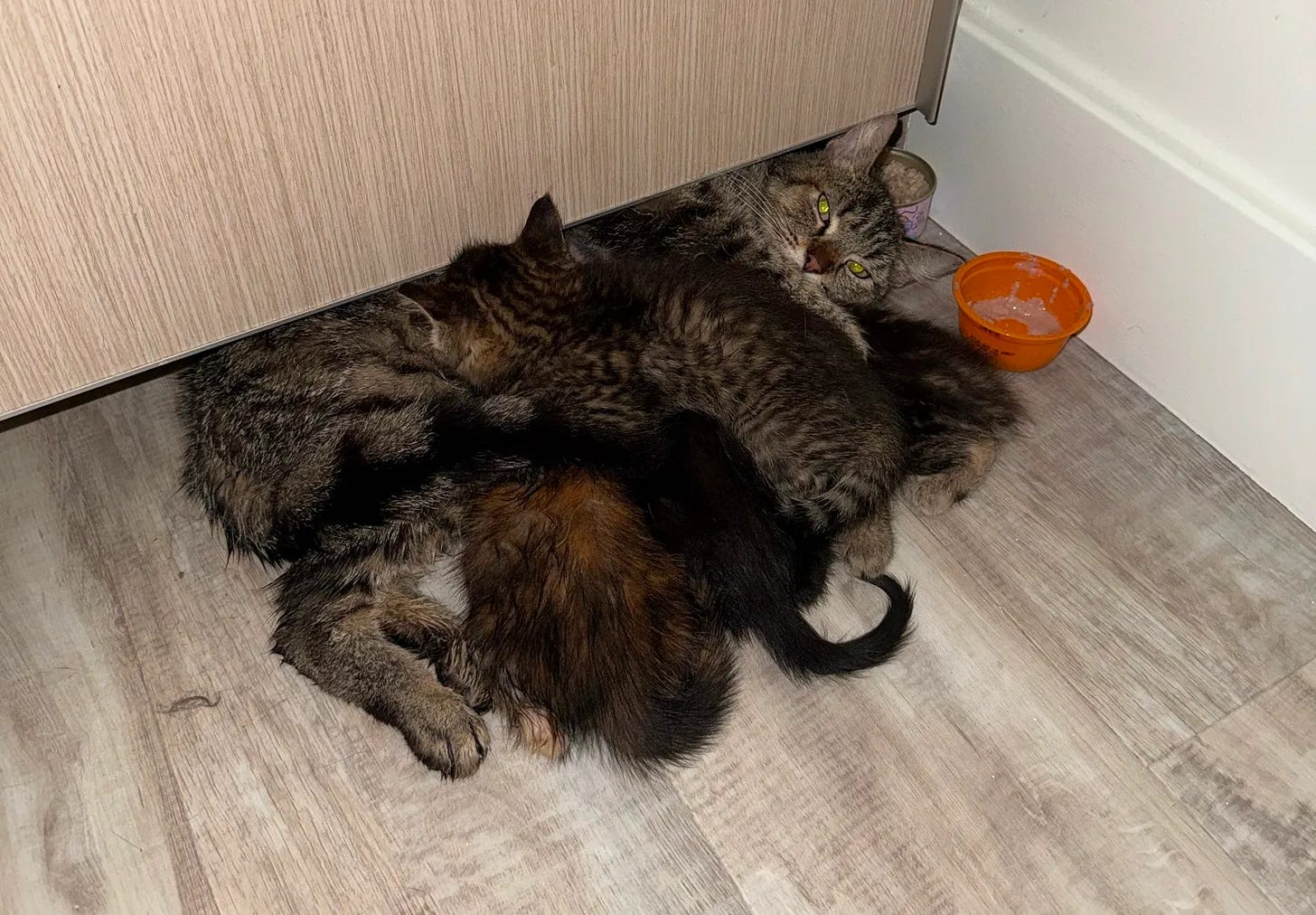
Just this month, a shy, little stray and her six kittens were turned away from every San Francisco Bay Area pound save one, which offered death. This is not an aberration, as even motherless neonates are turned away from local municipal “shelters.” Nextdoor posts are filled with cats and kittens who have no tax- or philanthropic-funded “shelter” to go to. This isn’t a rural area in some impoverished Southern state. It is a very cosmopolitan urban area; some would say the most “progressive” and “cosmopolitan” urban area in the U.S., certainly one of the country’s wealthiest communities, the center of the nation’s tech economy, where the median home price is over $2 million, and where per capita funding rates for animal services rank at the top of the pack and private SPCAs take in $50 million per year and have over $130 million in the bank.
Of course, the silver lining here, to the extent there is one, is that if “shelters” aren’t taking them in, they aren’t killing them. But turning them away or taking them in and putting them to death are not the only two options.
None of this is meant to suggest that we haven’t made some progress. Compared to a decade ago, killing is significantly lower. But we have lost ground since the pandemic gave “shelters” the excuse to curtail services, which they have not fully brought back. Against this complacency and abdication of duty, there are dedicated shelter directors who redoubled their commitment to the principles that made the No Kill movement meaningful in the first place. These facilities remain open-admission and fully embrace the programs and services of the No Kill Equation. As a result, they continue to report placement rates of 98% to 99%.
Their work proves what has long been true but too often ignored by bureaucrats, legislators, pound managers, and self-serving organizations like Best Friends: many of the obstacles to creating a truly humane society are not a question of numbers, space, or resources — they are political, institutional, and ideological. The decision to kill in the face of alternatives, the consistent refusal by many shelters to reopen adoption floors fully, and to continue turning animals away, is not a reflection of need but a choice. And Best Friends knows this, as they have encouraged these pounds to make those poor choices.
With the backing of Best Friends, some shelters have turned temporary pandemic restrictions into permanent policy, closing their doors to the public and allowing access only by appointment. This means that volunteers, rescuers, families searching for lost pets, and potential adopters are no longer free to walk in. Yet for the animals inside, those everyday visitors are not just foot traffic — they are a lifeline. Visitors bring stimulation, exercise, companionship, and, most importantly, the chance to be seen and adopted into a home. Studies prove that requiring appointments decreases the number of animals who find homes by a whopping 82%. For many animals, the decline in adoptions amounts to a death sentence.
At the same time, reduced access limits the number of volunteers available to provide enrichment and socialization. Without regular human interaction, time outside their kennels, and mental and physical stimulation, animals can become increasingly stressed. That stress can manifest as illness or behaviors that may be labeled as “aggressive” or “kennel crazy,” putting them at even greater risk of being killed.
These policies also threaten to undo years of progress made by the No Kill movement, which emphasized transparency, public access, and expanded adoption and reclaim hours as essential tools for accountability. Public presence inside shelters acts as a safeguard — rescuers, volunteers, and community members serve as the eyes and ears that help prevent neglect and abuse. When access is restricted and visits must be scheduled in advance, that layer of oversight disappears, leaving animals with fewer advocates and less visibility, and increasing the risk that their suffering goes unnoticed.
Although Best Friends fundraises off of the No Kill success of others and still uses No Kill catchphrases like “save them all,” it increasingly takes regressive positions that undermine No Kill efforts and legitimize killing as it has grown into an organization with $126 million in annual revenue and $153 million in assets. For example, Best Friends opposed legislation to make it illegal for municipal pounds to kill animals who non-profit rescue organizations are willing to save and opposed pre-killing notification to encourage adopters and rescuers to come forward, consigning thousands of animals to death. And this may be the least shocking thing about the organization.

According to a recent investigative report, what is now Best Friends Animal Society began — according to survivors interviewed in that report — as a cult known initially as The Process Church of the Final Judgement. Children born into the group recount how they were separated from parents and raised in communal “Faith School” settings. Entire families were broken up; children often had no stable relationships with their biological parents.
The cult allegedly combined religious ritual — mixing Christian and Satanic worship, Earth-mother ideas, Asian spiritual elements, candle rituals, and a vague belief system — with a nomadic lifestyle. The group travelled with dogs, frequently moved between city chapters, and lived under a rigid hierarchy in which obedience to leaders was emphasized above all else.
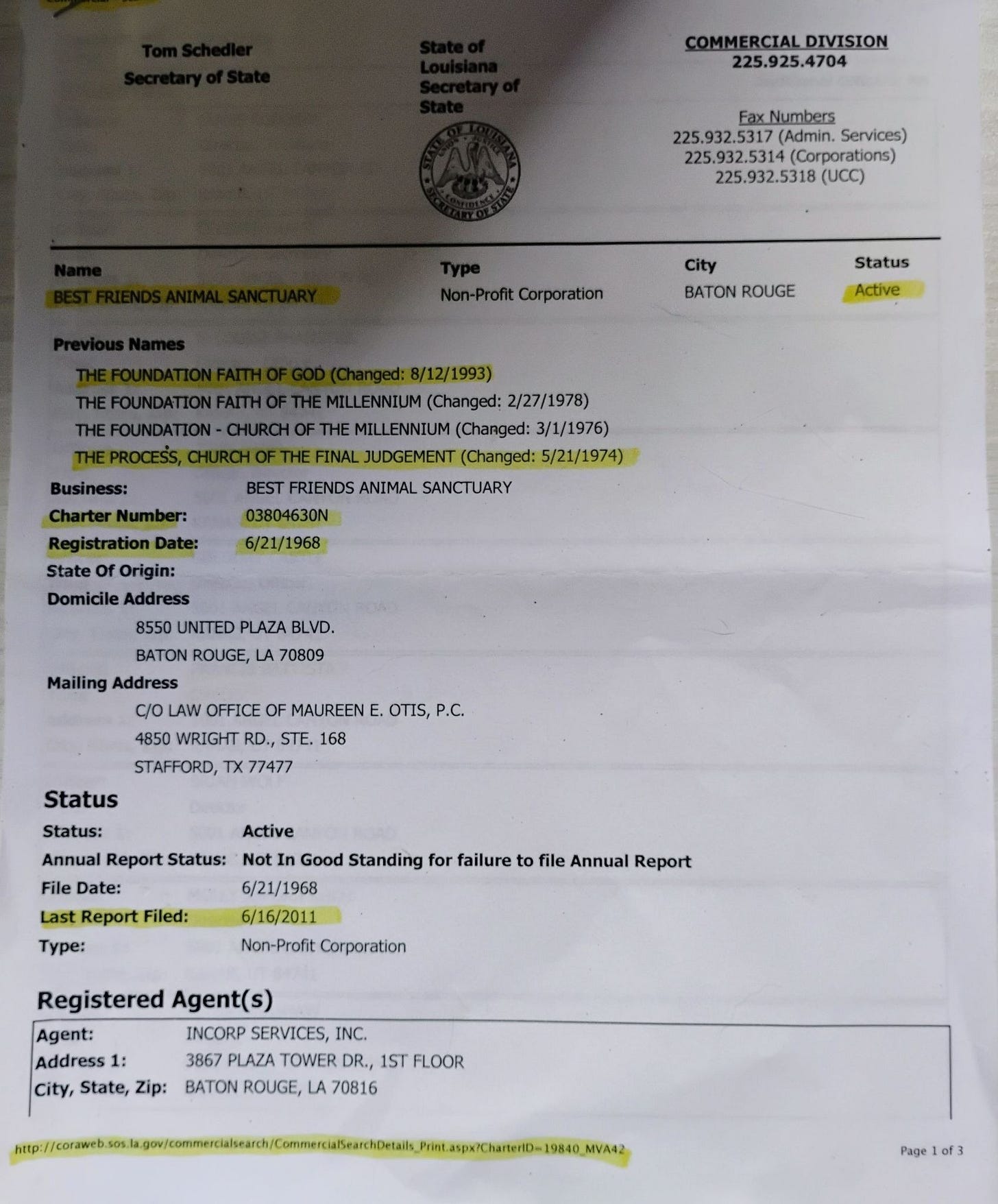
In the late 1980s, as the cult shifted toward animal work, a ranch in Southern Utah, near Kanab, was chosen as the headquarters. About 15 children were sent every summer from their Dallas branch to build the infrastructure that would become the sanctuary. The work included digging trenches, plumbing, pipelaying, dog-waste cleanup, and other labor-intensive tasks. The kids worked 10–12-hour days for weeks without pay.
In 1991, the organization rebranded as Best Friends Animal Sanctuary and obtained nonprofit, tax‐exempt status. Over the following decades, it grew into one of America’s largest charities.
The timeline on Best Friends’ website refers to its founding in 1984 as the moment when “a scrappy group of friends” came together to start the organization. But according to survivors, that narrative omits two preceding decades: years spent inside a cult, family separation, communal control, and child labor.
Critics argue this omission ignores generations of children who contributed unpaid labor under coercive, potentially abusive conditions. Former members describe not only forced labor but also emotional neglect, instability, and at times, physical abuse. One of the survivors recounts being hit on the head, shouted at, or emotionally manipulated by adults in positions of authority. The environment lacked stable parental affection, consistency, or emotionally safe relationships. Some children fared worse than others; a few were systematically targeted for abuse.
When approached for comment, Best Friends’ public relations declined to address questions about what they called “ancient history.” Yet, some of these founders are still associated the organization, and Best Friends continues to take regressive positions that enforce cult-like rigidity and undermine transparency. This includes advising municipal shelters to forbid volunteers from exposing killing and inhumane conditions, by enacting what amounts to an illegal code of conduct policy that explicitly states that, “Any negative posts on social media will not be tolerated.”
In the end, the question about national rates of pound killing should not come down to branding, rhetoric, fundraising, or well spun statistics. The central question is whether animals live or die, and whether the public is told the truth about why. Inflated claims and selective data may generate donations, but they do nothing to protect the animals turned away at locked doors, the ones who die unseen in kennels, or those never counted at all. Real progress requires honesty, transparency, and the courage to confront challenges, not obscure it. Until that happens, the gap between what is promised and what is practiced will continue to cost animals their lives, no matter how often Best Friends insists otherwise.
Managed Intake is the biggest crock of crap to come down the pike in years. Leave the animals on the streets to fend for themselves or leave them with the people who called for help. People don't call for help with an animal unless THEY NEED HELP!! We have gone so backwards in animal care simply unbelievable yet everyone except us stupid people who step up because we care are getting rich off the backs of the animals they pretend to help. Like I have said before" Who protects them from us"???????
Alabama enacted a law in 2015 called the Animal Census Reporting Act that requires all animal shelters to create monthly reports that include a detailed data set of animal intakes and outcomes (by species) as well as costs and expenses. Most shelters in the state do not post the reports publicly. Those that do often use a format that does not match the state law, making it difficult to determine the live release rate. While doing research for the Alabama Animal Advocates website in support of Kristin Yarbrough, I spoke with many county officials who had never heard of the law. In some places, you cannot request the reports using a form, by letter or by email and you are required to physically go to the county to obtain the information which I consider to be in violation or our open records act.
All this is to say that I live in Alabama and even if I devoted weeks to researching data for all the shelters, I would not be able to complete the task. It is not helpful that one of the most wealthy nonprofit organizations in the state, the Greater Birmingham Humane Society (which holds multiple municipal contracts), no longer publishes census reports on its website and does not respond to requests for the reports suggesting there is something to hide. The reports I was able to obtain for 2024 showed a dog live release rate of less than 50% which seems inconsistent with the celebrity status of the CEO in the state who has a huge following, a tremendous amount of influence and routinely brings animals to her facility from outside her service area, including other states, through a partnership with The Bissell Pet Foundation.
The dashboard maintained by BFAS is full of data for nonprofit shelters which are inherently No Kill because they limit intake. I can't speak to what is happening in other states, but in my state the population control killing continues despite the fact that the No Kill Equation has been available for the taking for 20 years and can be used even in counties with tremendous resource challenges. We do have veterinary deserts. I would love to see BFAS put some money toward mobile spay/neuter/veterinary operations to take services to places where they are needed most.