

A San Francisco Chronicle investigation traces the rise and fall of Miranda’s Rescue, a Northern California nonprofit that for years marketed itself as a sanctuary where animals would receive lifelong care or be adopted into new homes. Instead, hundreds of dogs entrusted to the rescue are alleged to have been systematically killed while shelters, donors, and families who surrendered animals to the sanctuary believed they had been saved.
Public agencies across California paid Miranda’s Rescue to accept difficult-to-place animals. For example, Oakland Animal Services paid Miranda’s Rescue $376,000 to send 827 dogs since 2020. Yet investigators reported that after reviewing documents, they found only a single adoption record, raising immediate questions about what happened to the hundreds of other animals.
According to investigators, Shannon Miranda, the founder, orchestrated a scheme in which animals were accepted from shelters and owners in exchange for substantial fees, then those animals were killed rather than cared for or adopted out. The article reports that authorities believe the motive was financial: collecting hundreds of thousands of dollars from public shelters and private owners while avoiding the expense and effort of housing the animals.
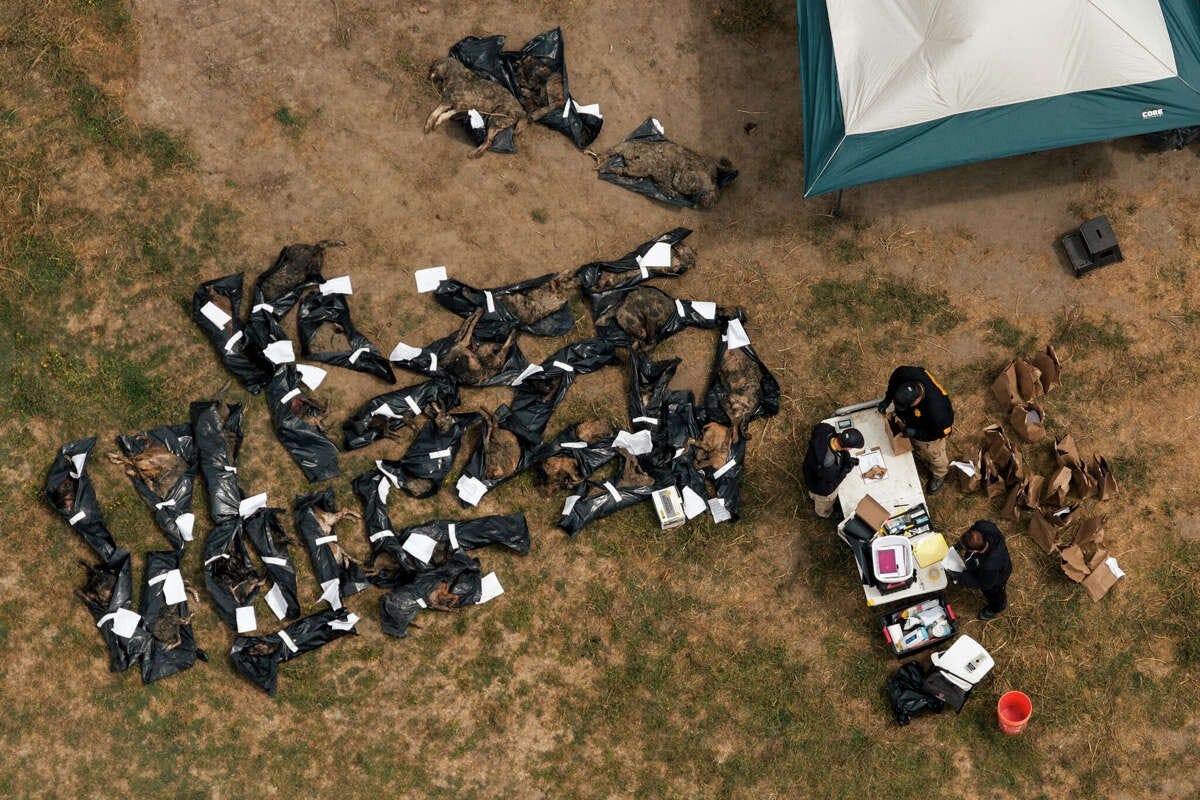
As investigators searched the property, they uncovered evidence that appeared to support those allegations, including blood spatter, spent .22-caliber shell casings, more than 600 dog collars, and burial sites containing large numbers of canine remains. Many of the recovered dogs were identified through implanted microchips that traced them back to shelters. In some cases, those shelters were told the dogs had been adopted.
The red barn

In interviews with law enforcement, Miranda acknowledged that he sometimes led dogs to a red barn on the property, placed wet canned food before them, and while they were eating, shot them between the eyes with a .22-caliber rifle. Investigators later described finding evidence consistent with those accounts inside the barn. Jesse Armstrong, a former employee, recalled disturbing experiences while working at the rescue as a teenager. He said Miranda instructed him and other boys to spread powdered limestone across a field behind the red barn, something Armstrong only later realized could help mask the odor of decomposing animals. Armstrong also described being shocked when he discovered decomposing dog bodies loaded into a tractor bucket, including a friendly dog he cared for only days earlier.
The investigation also examines Miranda’s background and the warning signs that, in hindsight, may have foreshadowed the alleged misconduct. Investigators cited a 1993 embezzlement conviction — later expunged — as part of what they described in a search warrant affidavit as a broader pattern in his business dealings. The investigation further questions Miranda’s repeated claims that many dogs were aggressive or gravely ill. Two women who had worked at a veterinary clinic where Miranda used to bring animals for “euthanasia” said many of the dogs were healthy, friendly and well behaved despite being labeled as dangerous or sick. One former kennel attendant recalled that dogs described as “aggressive” often showed no such behavior when handled by clinic staff, casting doubt on Miranda’s explanations for why they needed to be killed.
Complaints from neighbors, former employees and advocates accumulated over decades, but meaningful intervention came only after private citizens cut through the fence in the middle of the night, trespassed on the property, and dug up the bodies. To date, no criminal charges have been filed, while investigators continue sifting through financial records, digital evidence, and physical remains to uncover the full scope of the alleged scam.

In a statement released through his attorney, Miranda denied claims that he killed animals for profit or space, and called the Humboldt County Sheriff’s investigation politically motivated, accusing law enforcement of employing aggressive search tactics and selectively leaking information to distort the truth and fuel public hostility.
Miranda’s Rescue continues to operate.
The white shed
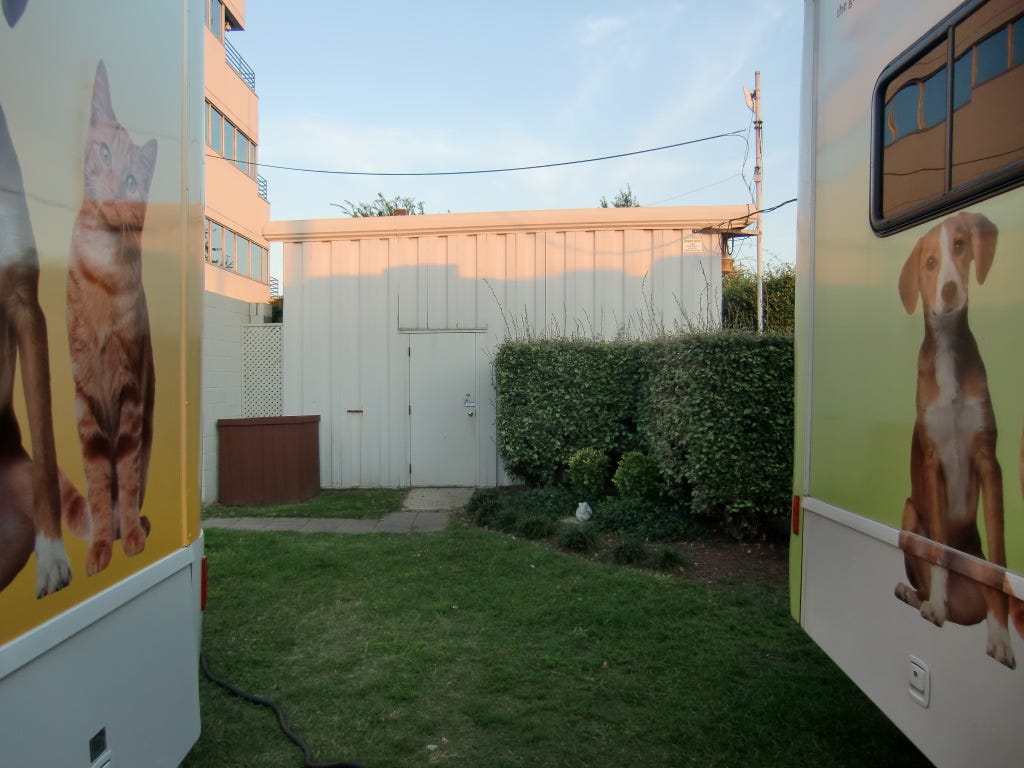
The scandal is reminiscent of a similar one involving People for the Ethical Treatment of Animals (PETA), which is also alleged to have lied about “saving” animals and instead killing them. Although in PETA’s case, no money was exchanged and therefore may not rise to the level of a criminal action, both cases exemplify deception where organizations leverage public trust and institutional legitimacy to mask practices that fundamentally contradict their stated missions.
According to Heather Harper-Troje, a former PETA employee,
“I know from first hand experience that the PETA leadership has no problem lying. I was told regularly to not enter animals into the log, or to euthanize off site in order to prevent animals from even entering the building. I was told regularly to greatly overestimate the weight of animals whose euthanasia we recorded in order to account for what would have otherwise been missing ‘blue juice’ (the chemical used to euthanize), because that allowed us to euthanize animals off the books. I was told regularly to say whatever I had to say in order to get people to surrender animals to me, lying was not only acceptable, it was encouraged… Contrary to what PETA maintains, the majority of animals it takes in are not beyond hope, in my experience many would be considered highly adoptable by a shelter, the ‘better off dead’ line is one that is dragged out in order to excuse what they do — and it’s a lie.”
She describes picking up a litter of healthy puppies from someone who thought that PETA was going to find them a home:
“What was referred to as the ‘shelter’ was a large, empty storage closet across from our office. The only other holding facility we had was in the warehouse, where the animals were euthanized. And when I did use the room across from my office as a holding area for animals, Ingrid would ask why I hadn’t already euthanized them: one time nailing me to the wall because the litter of puppies I’d placed in there for a night had pooped everywhere; I was told to euthanize the puppies immediately.”

But a May 2005 criminal investigation offers the most stark comparison, when the bodies of dead dogs and cats began turning up in the trash bin of a supermarket in North Carolina. Local police eventually arrested two PETA staff members.
According to a Roanoke News Herald investigation, Ahoskie Police Detective Sgt. Jeremy Roberts began investigating after a worker discovered a discarded trash bag containing a dead animal behind a local Piggly Wiggly supermarket. Arriving at the scene, Roberts noted a “strong odor coming from the dumpster” and recovered 21 dead dogs packed inside 20 heavy-duty trash bags. Similar dumping incidents recurred in the same dumpster over the following weeks, yielding 17 dead dogs and three cats on June 2, and an additional 18 bags containing 20 dead dogs on June 9.
The investigation led police to surveil PETA employees Adria Hinkle and Andrew Cook as they traveled in a company van to collect animals from the Ahoskie Animal Hospital (AAH) and the Bertie County shelter. After Hinkle killed the collected animals inside the van, detectives shadowed the vehicle to the Piggly Wiggly dumpster. As Roberts and a fellow detective approached the parked van on foot, Roberts testified that he could hear the “‘thump, thump’ of heavy objects striking the bottom of the empty dumpster” before the van accelerated away. Officers executed a traffic stop in the parking lot and arrested both occupants.
A search of the dumpster yielded nine bags holding 16 dead dogs, while a subsequent inventory of the van revealed another 12 bags containing eight dead dogs and 14 dead cats. A search of the PETA van uncovered supplies including trash bags, animal food, leashes, PETA manuals, and a tackle box filled with syringes, needles, and liquid “euthanasia” drugs.
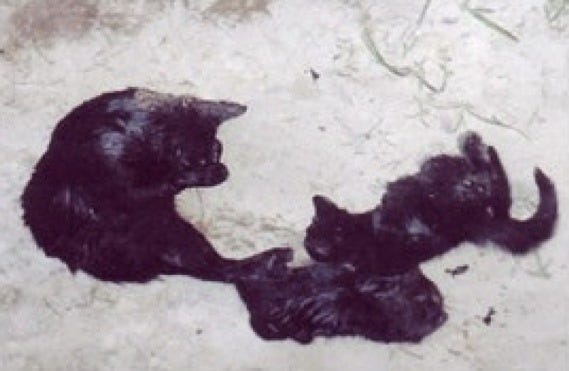
Testimony confirmed that several of the animals were healthy and adoptable, including a mother cat and two kittens handed over by AAH veterinarian Dr. Patrick Proctor. Dr. Proctor explained that PETA had explicitly promised to rehome the pets, stating, “They were just kittens we were trying to find homes for. PETA said they would do that…” After inspecting another dumped animal — a six-month-old lab mix with an injection mark in its leg — Dr. Proctor noted that “the animal that I found was a very healthy six-month puppy that had been killed that day,” concluding, “PETA will never pick up another animal from my practice.”

PETA has also been caught stealing and killing a family’s dog. On October 18, 2014, two PETA representatives backed their van up to a home in Parksley, VA, and threw biscuits to Maya, who was sitting on her porch. They hoped to coax her off her property and allow PETA to claim she was a stray dog “at large” whom they could legally impound.
Maya refused to stay off the property and, after grabbing the biscuit, ran back to the safety of her porch. One of the PETA representatives went onto the property and took Maya. Within hours, Maya was dead, illegally killed with a lethal dose of poison.
PETA initially denied taking the dog but surveillance film proved otherwise. After they were confronted with the film, a PETA spokesperson subsequently claimed Maya was killed by “mistake,” and, defying credulity, explained that the same PETA representative who had earlier sat on the porch with Maya’s family, talking to them about her care, and who was filmed taking Maya from that same porch, mistook her for a different dog.
The “apology” was not only a devastating admission of guilt but evidence that killing healthy animals was business as usual for PETA employees — so commonplace that the only excuse PETA could offer for Maya’s death was that in taking her life, a PETA representative had mistaken her for another healthy animal they had decided to kill.
Ultimately, PETA would pay a mere $500 fine to the Virginia Department of Agriculture & Consumer Services (VDACS) for the killing and settle the civil lawsuit from Maya’s family for $49,000, a small fraction of the $66 million they raised that year. Undeterred, PETA continues to kill animals to this day, over 90% of the animals they take in. In 2025, for example, they killed 1,718 animals — roughly five animals a day, every day — with hundreds more sent to local pounds. The total known death toll is now well over 50,000.
Orange dots
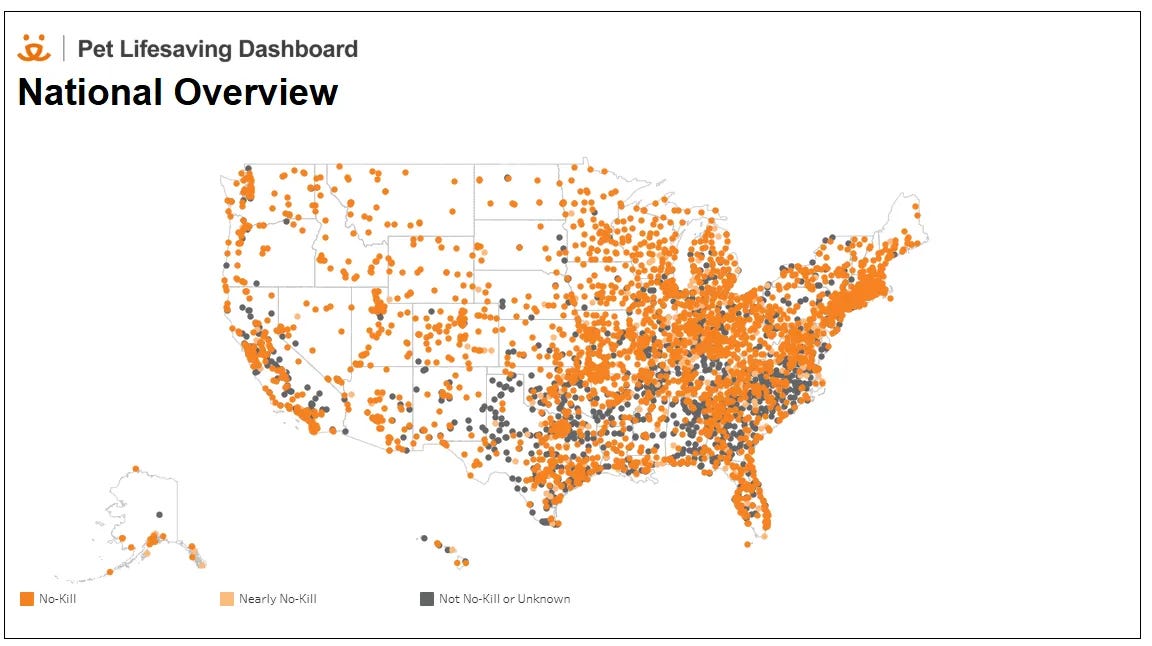
Unfortunately, Miranda’s Rescue and PETA are not the only organizations that have been accused of purposely misleading the public. The move by public shelters to claim they are No Kill, but doing so by turning animals away, some of whom have later been found dead, injured, or severely emaciated is another, even more common, example of how agencies entrusted with the care of animals and enriched in the process betray them.
The “orange dot” is the symbol used by Best Friends on its online dashboard to mark a community that they claim is “No Kill.” Aside from fudging the data to make the claim, as I have reported elsewhere, the orange dot ignores the fact that most at-risk animals are barred from entering the “shelter.”
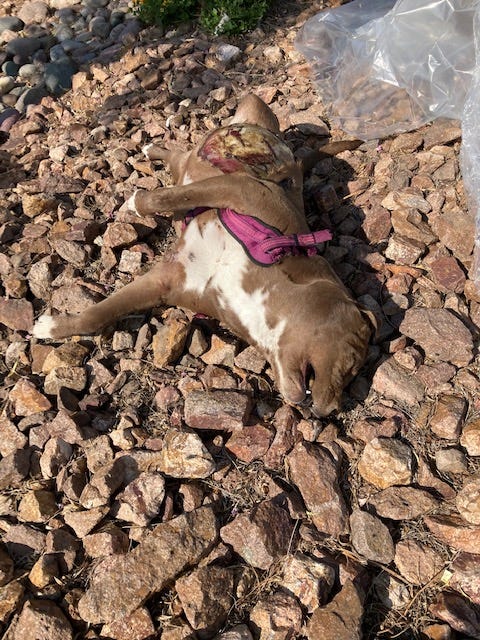
These animals — often left on the street to fend for themselves — effectively become “ghosts.” They don’t simply disappear — indeed, they are still suffering, they are still dying, and they still matter. But because they are not counted in official shelter intakes, they vanish from the records, rendered invisible by bureaucratic indifference and obfuscation. Like Miranda’s claim they were adopted or PETA’s claim they were irremediably suffering, this allows organizations to maintain a facade of success, shielding the grim reality of their fates.
Collectively, three of the wealthiest U.S. organizations, including Best Friends, have $776 million in annual revenue and $1.2 billion in assets. The ASPCA takes in $390 million in revenue and has $575 million in assets, including $310 million in investments and $105 million in savings. The Humane Society of the United States receives $260 million in annual revenue and has $454 million in assets, including $370 million in investments and $31 million in savings. Best Friends Animal Society has $126 million in annual revenue and $153 million in assets. Given the sheer wealth at their disposal, why aren’t things better for animals than they are?
Because despite such wealth, the ASPCA spends only about 2% on animals in shelters. Most donations go to fundraising and salaries. The amount HSUS spends to help these animals is even less than that, about 1%. Similarly, Best Friends uses donor funds to purchase for-profit businesses such as a hotel and gym, and spends millions enriching the founders who own the logo and license it back to the organization.
But even the paltry amount they spend on shelter animal programs isn’t necessarily being used to help. These groups are lobbyists for “shelters” that kill animals, not the animals in those shelters. Among other things, for example, the ASPCA killed 20 dogs in transport, allowed dogs to starve, killed abused dogs despite rescue groups willing to save them, killed a young woman’s dog and tormented her, fought legislation to save lives, effectively putting hundreds of thousands of animals into an early grave, and covered up abuse by its employees.
Best Friends, the ASPCA, and HSUS remain rich and are getting richer.
* * *
In the final analysis, the tragedies at Miranda’s Rescue, PETA, Best Friends, the ASPCA, and others are not isolated failures. From public shelters that routinely kill animals or, conversely, claim success by refusing to admit the most vulnerable, to law enforcement agencies and oversight bodies that dismiss reports of cruelty as low-priority or ignore red flags until it is too late — Jesse Armstrong notified the police when he quit working at Miranda’s Rescue only to be ignored; VDACS levied a paltry fine against PETA for stealing and killing Maya — they are symptoms of a systemic devaluation of animal lives across the board. As I’ve previously written too many times to count, animals are being betrayed, neglected, abused, or killed by the very agencies tasked with protecting them. Without real accountability, it leaves the “ghosts” of their policies to suffer in the shadows, while allowing organizations to get away with (proverbial) murder.
Another disreputable shelter practice to legitimize killing healthy animals is intentionally mislabeling them “unhealthy and untreatable” when by every standard they are not. That is a local Multnomah county practice where the pound is never made to justify euthanasia practices. The only avenue I know to uncover and expose those practices is through ordering and paying for public records often made deliberately expensive. And then publish and share those records everywhere. None of those efforts takes away the sorrow of it.
There was a sweet old German Shepherd on tv today needing a home, so I called a relative to take a quick look.
It takes a lot of dedication to rehome dogs well.
The shelter is doing very well at helping the animals and people in their community.
There seem to be bad apples in every profession.
But thanks for keeping us aware of the failures and what needs to happen to change it.
But sending all those dogs to their death means some basic checks of that rescue weren't being done.