

Two years after her abuse and killing at the hands of those tasked with protecting her, the criminal cases against the former animal control employees remain unresolved. Eight workers were arrested on 34 charges after investigators concluded that records were falsified to conceal the cruel killing that left Chai dying on the floor. But despite the dramatic arrests, no publicly reported trial or final disposition has followed. The defendants bonded out, the cases drifted through preliminary proceedings, and justice for Chai remains unfinished.
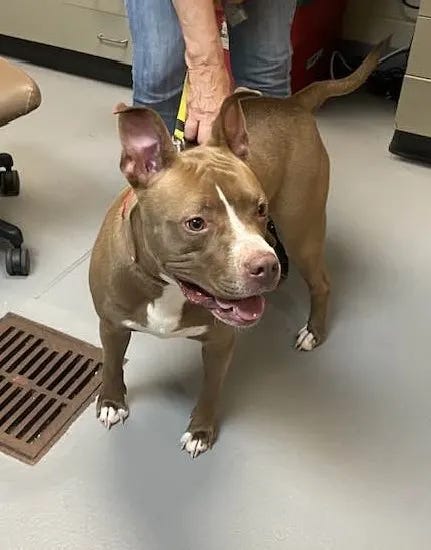
Two years ago today, a dog named Chai died painfully on the floor of a government pound, illegally killed by the very people charged with protecting her. As I wrote about it then:
On June 4, 2024, Chai, a brown and white “pitty-mix,” was surrendered to Columbus Animal Care & Control in Georgia. The reason for surrender was listed as “no room.”
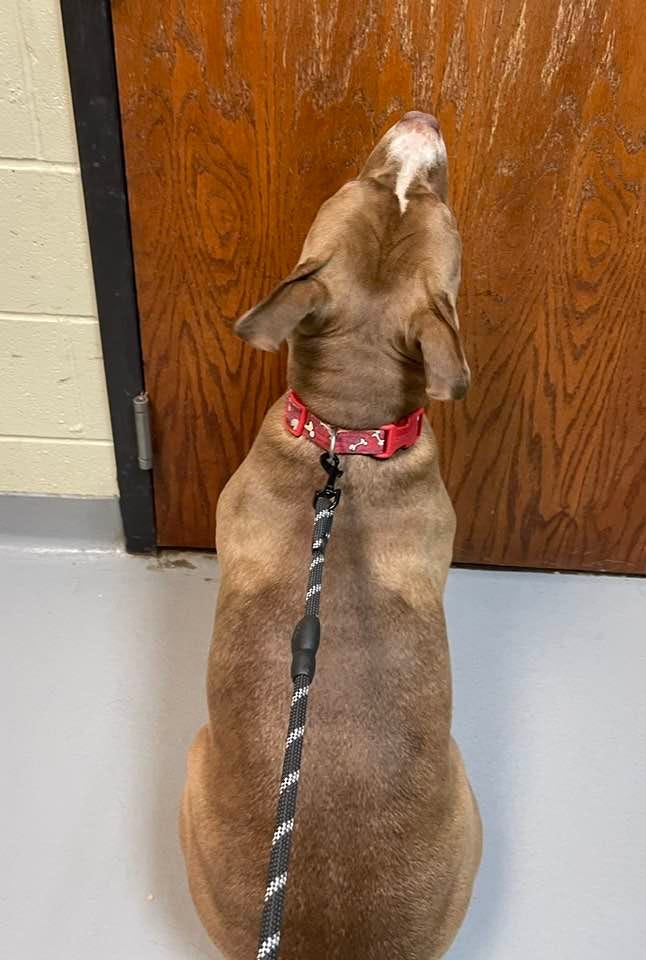
After her family left, Chai watched the door, waiting for them to return. They didn’t. Still, she was one to two years old and had her whole life ahead of her. And through the agency that is supposed to give dogs like Chai a second chance when things go wrong, she could find a worthy family — one that would give her the life she deserved. This was especially true for a dog like Chai, described on her paperwork as “affectionate” and “playful,” and good with everyone: cats, dogs, men, women, kids, and strangers.
Of course, we now know that did not happen. Not only did they choose to kill her, they killed her in one of the cruelest ways possible:
As seen on video obtained under the Georgia Public Records Act, staff botched what appears to be six attempts to inject her with a lethal dose of barbiturates. After the first two failed, Columbus Animal Allies notes that “Chai gets up, almost knocks over a chair, walks at least 10 feet away from the original area, and continues to struggle while being held down by a CACC staff member.”
Staff would bungle several more attempts to kill her by intravenous injection (IV) before resorting to intracardiac injection — heartsticking her — a process that involves plunging a syringe through the chest wall and several layers of muscle into a dog’s heart. An animal killed by a heartstick feels extreme, severe pain (due to the amount of nerves) and then suffers a heart attack.
To get to the heart, the needle would have to penetrate the skin, body wall with costal musculature, costal pleura, pleural cavity, pericardial pleura, fibrous pericardium, serous pericardium, pericardial cavity, epicardium, myocardium, endocardium, ventricular chamber, and if the lung is penetrated, the needle must pass through the pulmonary pleura and lung tissue itself. It is so painful that Georgia law only allows it to be done when the dog is unconscious. (GA Code § 4-11-5.1(a)(3).)
After heartsticking her, the employees leave while Chai is still alive. That, too, is illegal under Georgia law: “No dog or cat may be left unattended between the time euthanasia procedures are first begun and the time death occurs.” (GA Code § 4-11-5.1(g).)
“Chai lies on the floor alone with the syringe sticking out of her side, the syringe visibly moving several times. Employees step over her carrying brooms and mops.” Later, “the syringe sticking out of her body begins moving frantically. In the following minutes, the syringe continues to move periodically as employees step over her.”
None of the employees show her any concern or regard while she lies on the floor. Moreover, “CACC employees walk multiple dogs on leashes past Chai while she lies dying on the floor, a cart full of dead dogs waiting a few yards away.”
It is also a violation of Georgia law for a dog to be “disposed of until death is confirmed by a qualified person.” (GA Code § 4-11-5.1(g).) That never happens. Instead, “an employee struggles to pull a heavy cart full of dead dogs closer to Chai. That employee and another staff member pick up Chai by the legs and throw her into the cart.” Later, “two employees remove another dead dog from a run, carry the dog past a row of runs as living dogs look on, and toss that dog’s body in the cart next to Chai’s.”
When I first wrote about Chai’s death, I noted that what happened to her was not merely an individual failure. It was the predictable outcome of a system that had become unaccountable, secretive, and indifferent to suffering. A “shelter” in name only, the Columbus pound was a dirty, vile facility run by the department that oversees trash collection. It was not surprising that they also treated animals like trash. Chai was literally tossed in a dumpster and discarded in a landfill.
After her killing and the subsequent public outcry, the pound veterinarian — the kind of man we are bound to consider unserious, uncaring, calcified, dishonest, and incompetent if natural conclusions are to flow from actions and events — defended the staff and blamed the victim, saying Chai was not a friendly dog. It was a lie.
Not only did he refer to Chai as “he” and “him” in testimony before the council, indicating he was unfamiliar with the dog because Chai was female, but her intake, custody, and disposition records did not indicate any adverse behavior. On the contrary, those records referred to her as “affectionate” and “playful,” and Chai could be seen wagging her tail even as she was being injected with the first syringe of what would be seven attempts to kill her.
The veterinarian also claimed that except for killing her in the kennel area (in front of other dogs), “no wrongdoing took place, and all processes and procedures were followed during the euthanasia [killing] process.” That, too, was a lie.
Indeed, under questioning by councilors, the veterinarian admitted that the staff only used two cc’s of general anesthetic. “It should have been three or four.”
He admitted that Chai “should be totally under a general anesthetic before any attempt at an intravenous injection is made.” She wasn’t.
He admitted that they are required to verify death, and “that did not happen.”
He further admitted, “A stethoscope in this case should have been used. I don’t know why it wasn’t.”
But there’s more. On the paperwork, CACC staff claimed that Chai was killed by intravenous injection, the standard method, instead of intracardiac heartstick. She wasn’t.
But despite his dissembling, public outrage over the video forced authorities to act. The Columbus Police Department and the DEA launched a criminal investigation, executed search warrants, and uncovered evidence that pound officials had falsified records to conceal what happened.
On October 1, 2024, eight shelter employees were arrested on 34 criminal charges. Those arrested included the shelter manager, a field supervisor, an administrative coordinator, and the veterinarian, who resigned before being charged with false statements and writing, concealment of facts, and forgery in the first degree. Charges for the others ranged from animal cruelty to concealment of facts, “euthanasia” by unauthorized personnel, disposal of deceased animals, violation of oath by public officer, theft by deception, leaving of animals unattended, forgery (second degree), and failure to scan for microchips. Yet two years later, justice remains elusive.
All of the defendants quickly bonded out of jail. Cases were opened. Hearings were scheduled. Paperwork accumulated. But the prosecution has moved at a glacial pace, leaving many advocates frustrated that those responsible for Chai’s suffering have largely avoided being held accountable and may never be. The gap between dramatic arrests and meaningful justice has become its own scandal.
There is, however, one important development that would have seemed unlikely in the days immediately following Chai’s death: the system that killed her no longer exists in its former form. The arrests and suspensions crippled the city-run operation. Eventually, Columbus officials removed the facility from government management and transferred operations to PAWS Humane Society. The nonprofit now operates the facility under improved veterinary oversight, foster programs, and safeguards designed to ensure that no animal endures what Chai endured.
In 2023, the year before Chai was killed, killing was up 50% for dogs and 37% for cats. And those numbers did not include other negative outcomes, such as deaths in kennel and missing animals, which the agency did not publicly report on its website.
In 2025, the year after Chai was killed and PAWS had taken over, adoptions skyrocketed and the shelter finished the year with a 91% placement rate for dogs and 88% for cats. It is higher in 2026 year-to-date. Of course, there is still room for improvement, as the most successful shelters in the country are achieving placement rates of 98%-99%, but it is a far cry from the medieval dungeon that abused and killed Chai. And in addition to working harder to help animals in the shelter, they are working hard to help those outside of it: “The organization spayed and neutered over 2,000 community cats and provided 7,783 spay and neuter surgeries in total. They gave over 20,000 vaccines, implanted 2,815 microchips and administered 784 heartworm treatments.”
Yet no amount of progress can bring Chai back. It cannot erase the terror, her pain, or the betrayal she experienced at human hands. But it is a reminder that exposing cruelty matters. Accountability matters. Public outrage matters. Making people earn your vote matters.
Chai’s life was short. Her death was agonizing. But because the truth was not buried along with her, her suffering became the catalyst for change. Two years later, the criminal cases remain unresolved. The final chapter has not yet been written. But the shelter that killed Chai has undergone a transformation that stands as both an indictment of the past and a testament to the power of compassion.
Dear Nathan, If is sad and frustrating that those responsible for the cruel killing of sweet dog Chai have still not been punished as of now, two years since the incident. You point out the legal details through your brilliant legal mind. In my opinion, as l have mentioned many times in the past, the fact that dogs and other animals are Sentient Beings who deserve to be treated with the same respect as Human Beings, should serve as the legal reason why the Columbus, Georgia culprits should be punished as if they had killed a Human Being. Hopefully justice and logic will ultimately prevail.❤️🐶
As hard as this article is to read, it must have been even harder to write. Witnessing suffering is the ultimate compassionate act. Perseverance, patience, resolve, and faith will remedy hearts looking for justice and minds looking for peace. Chai is no longer on this Earth that is ever so brutal to homeless animals, but her legacy transformed a brutal system into a more compassionate one and highlighted the capability that humans have when given broad discretion to do their worst. It also highlighted what people will do when they're at their best.
Thank you for writing it, I remember this story when you first brought it to light. So grateful that PAWS took over, and hopefully the brutal thugs who killed her in such an inhumane and heartless manner will suffer the consequences.
Namaste,