In other news: A legacy of killing. The rhythm of care. Misinformation circulates about “pit bull” bite risk. State launches animal abuser registry. Do you have what it takes to save lives? Communities are looking for someone to run or help run their animal shelters. Carriage horse crashes in New York City. Advocates threaten a lawsuit to prevent deaths. Another week, another pet food recall. Dogs are learning by eavesdropping. New federal food guidelines undermine human and animal health.
These are some of the stories making headlines in animal protection:
County of Hawaii grants cats and their caretakers a reprieve

As reported last summer,
Despite opposition from 23 local animal welfare groups and receiving thousands of emails requesting a “No” vote, the Hawaii County Council voted to criminalize the feeding of community cats. According to Aloha Animal Advocates, the local organization that spearheaded opposition, the bill would have “thwart[ed] years of dedicated efforts to reduce and control the cat population” through sterilization and caretaking.
In addition to depriving cats of food and care, the bill also would have harmed the caretakers. A recent study found that approaches similar to those in the Hawaii bill lead to profound human suffering.
The law was supposed to go into effect on January 1. Thankfully, the county animal control agency has agreed to certify cat caretakers and allow them to continue sterilizing and feeding the cats.
A legacy of killing

New York State Assemblymember Donna Lupardo has announced that she is retiring and will not seek reelection to her seat. For dog and cat lovers, this is good news. Lupardo is responsible for the killing of an estimated 25,000 dogs and cats a year throughout New York State.
These are animals in “shelters” who rescue groups were ready, willing, and able to save, but who were instead put to death, and continue to be killed. As Chair of the Agriculture Committee, she would not allow the Shelter Animal Rescue Act (SARA) to come to a vote, even though it had the support to pass.
SARA would have made it illegal for New York shelters to kill animals if qualified non-profit rescue organizations were willing to save them. It was modeled on legislation passed in California and Delaware, as well as in municipalities across states, including Texas, Minnesota, and Indiana. Over 85,000 animals are saved each year in California alone because of a similar law.
Why did she block this common-sense, proven reform? Lupardo was doing the bidding of the regressive ASPCA, the Humane Society of the United States, and the New York State Animal Protection Federation, “humane organizations” in name only. She leaves behind a legacy of mass killing.
The rhythm of care

The story of Grimm, a little cat who was abandoned on the streets of Philadelphia, found a home in California, discovered the sink, and then asked that the sink be turned on 2,361 times last year. More importantly, it is a tribute to the rescuers who open up their hearts and homes to animals in need — who get up early and go to bed late, and turn their bathrooms and spare rooms into rehab clinics because someone has to.
Misinformation circulates about “Pit Bull” bite risk
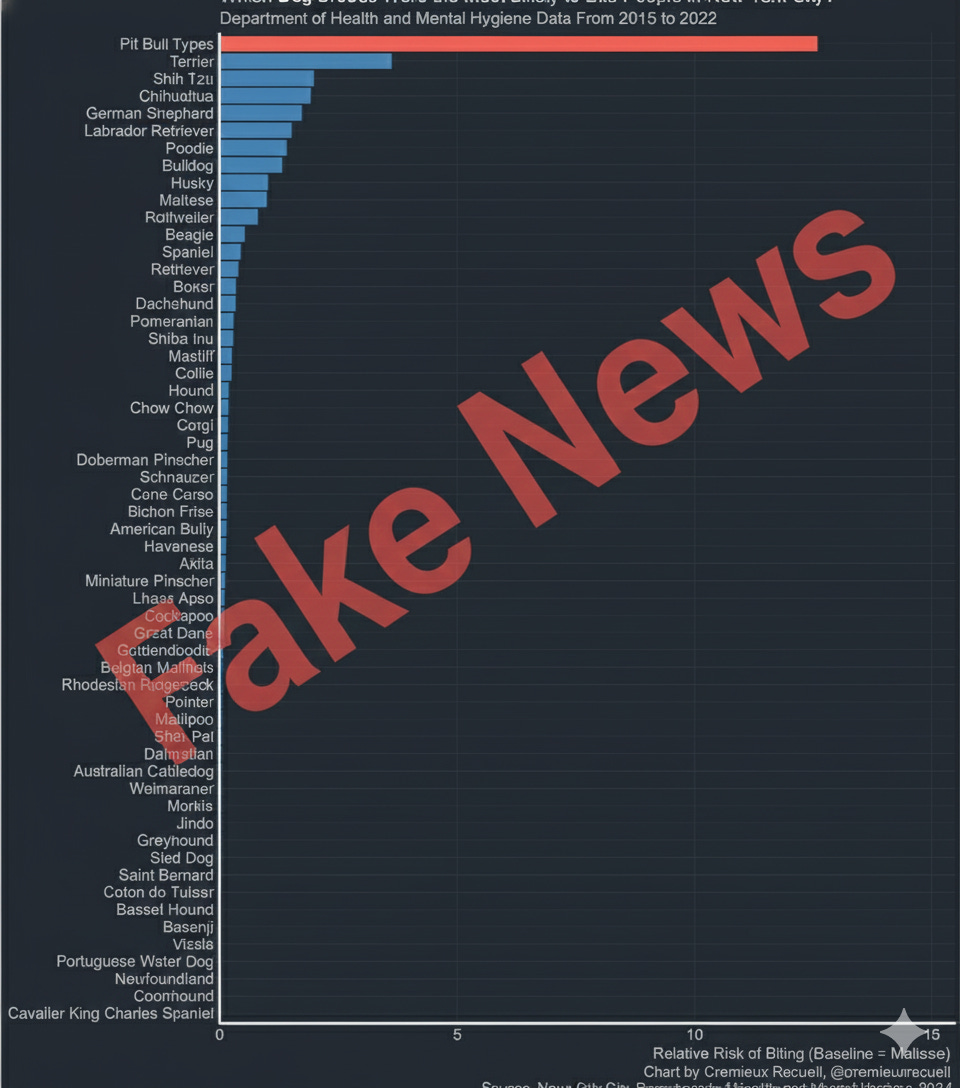
A chart has been circulating online claiming “Pit Bull Types” are over 12 times more likely to bite than other dogs in New York City. Its author is calling for all dogs who look a certain way to be killed, even though no such risk exists.
This claim has two inputs: the number of bites by breed (the numerator) and the population of that breed (the denominator). Both are systematically biased in ways that inflate the risk, including undercounting the population, visual misidentification, and aggregating dogs with a blocky head or a short coat into a single category. When you correct for the massive errors, the alleged risk simply evaporates.
Dog bites are rare events, even in a city with hundreds of thousands of dogs. In New York City, the vast majority of dogs labeled “Pit Bull Types” will never bite. Likewise, the vast majority of people will never be bitten by a dog. Only 0.039% of residents are bitten annually, and serious injuries occur at a rate of roughly 0.0035% across all breeds.
Scientific research also tells a very different story than the chart suggests. Breed is a poor predictor of individual behavior, and “agonistic threshold” (aggression) correlates nearly zero with breed. Not surprisingly, breed-specific bans kill many non-aggressive dogs but fail to reduce dog bites or improve public safety.
State launches animal abuser registry