

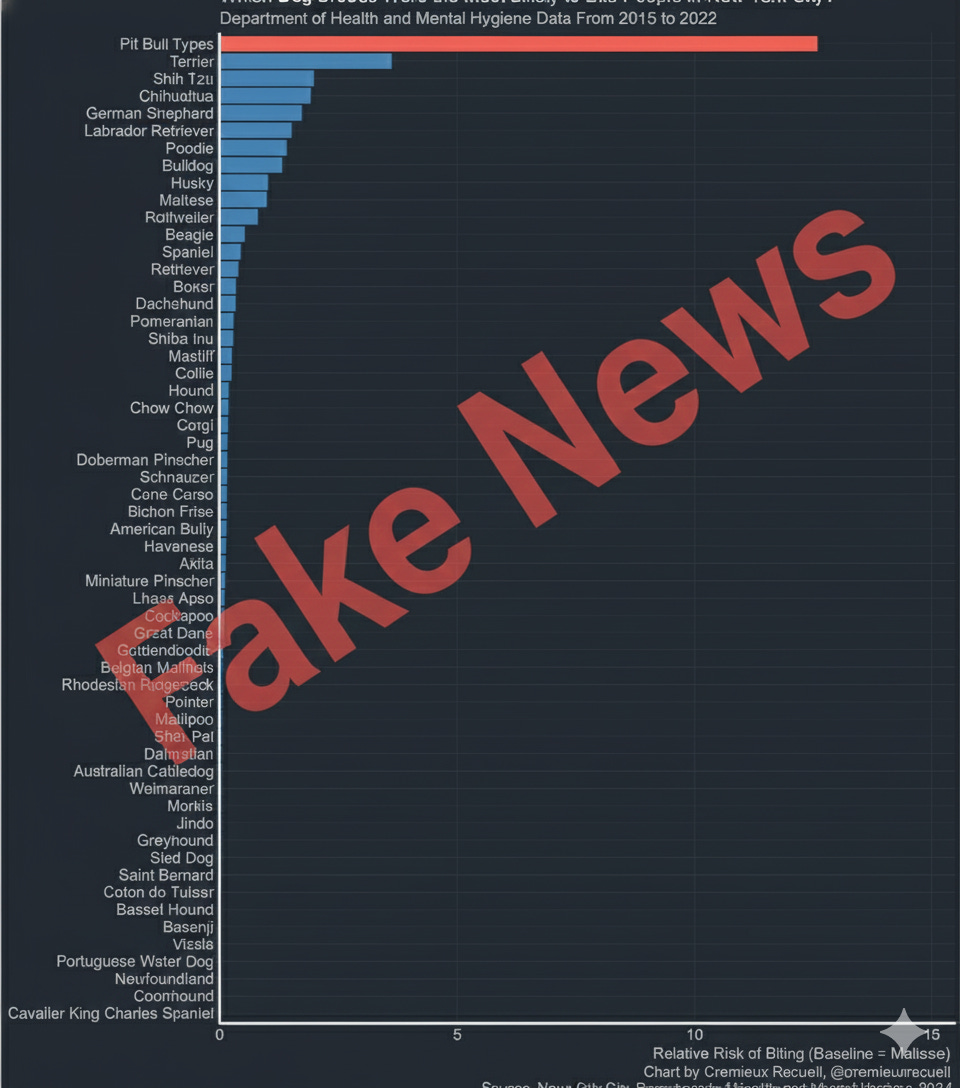
On X, Jordan Lasker, who goes by the internet name “Cremieux,” is attacking dogs alleged to be “Pit Bulls,” even endorsing calls for all of them to be killed. Jordan’s claims are primarily based on his own analysis of bite data from New York, in which he concluded that “Pit Bull Types” in New York City are 12.59 times more likely to bite than Maltese. No such risk exists. This claim has two inputs: the number of bites by breed (the numerator) and the population of that breed (the denominator). Both are systematically biased in ways that inflate the risk, including:
Data Discrepancy: The chart uses a “deflated denominator” because low licensing rates and housing bans discourage owners from registering “Pit Bull Types,” making their bite rate appear artificially high.
Visual Misidentification: The chart uses an “inflated numerator,” making their bite rate even higher. Accuracy is compromised by the “wastebasket effect,” in which victims and witnesses frequently mislabel mixed-breed dogs as “Pit Bulls” based on general physical traits, such as a blocky head or a short coat.
Aggregation vs. Fragmentation: The data unfairly groups multiple breeds into a single “Pit Bull” category while keeping other breeds separate, inflating bite counts for the former and deflating them for the latter.
When the flaws are corrected, the risk evaporates.
Scientific research also contradicts the chart’s implications, showing that breed is a poor predictor of behavior and that aggression has nearly zero correlation with a dog’s breed. Not surprisingly, breed-specific bans kill many non-aggressive dogs but fail to reduce dog bites or improve public safety. Given that dog bites across all breeds are exceedingly rare events in New York City — affecting only 0.039% of residents annually — and serious bites across all breeds requiring hospitalization even rarer — only 0.0035% — the data does not support the “mass killing” of an entire population of dogs.
Even if one were to dismiss all of this and falsely believe, despite the evidence, that “Pit Bull Types” are biting at higher rates, the conclusion they should reach is that people select them for aggression because of their muscular appearance. The solution then is to step up enforcement of dogfighting, which we should be doing anyway. If one believes, again despite the evidence, that they are genetically predisposed to violence, then, given how rare dog bites are and even rarer serious bites are, the logical conclusion is to sterilize them, which we should be doing anyway for all dogs.
The conclusion is not that we should systematically round up and kill all dogs who look a certain way, regardless of behavior or genuine, genetic heritage. In addition to the immense moral toll, the cost of such a program would not justify the killing. This is, of course, why breed-specific legislation is on the decline across the United States. It’s expensive. It does not improve public safety. It is bad policy. It’s evil. Unfortunately, it is encouraged by people like Jordan, who stoke racial tensions for internet “hot takes.”
For a one page summary of key flaws in the data and methodology, click here.
Garbage in, garbage out.


A year and a half ago, a chart circulated online purporting to show “Which Breeds Were the Most Likely to Bite in New York City,” based on data from the Department of Health and Mental Hygiene (DOHMH). Jordan Lasker, the author of the chart, claimed that “Pit Bull Types” were over 12 times more likely to bite than the Maltese. I ignored it because it constitutes statistical malfeasance, and I did not want to draw attention to it, especially given the national obsession with confirmation bias rather than truth-seeking. And it came and went without much of a ripple.
But it has reared its ugly head again, and now Jordan is amplifying other reactionary voices calling for the killing of every dog labeled “Pit Bull” in America.
In the interests of dogs, the people who love dogs, the truth, and good government policy, this is my analysis of why it is wrong.
The chart obscures the fact that the vast majority of dogs, including those alleged to be “Pit Bull Types,” will never bite.
The chart purports to rank breeds by bite risk, with “Pit Bull Types” dramatically outpacing all others. The most basic problem is a mismatch between the chart’s title — “Which Breeds Were the Most Likely to Bite” — and its metric. It does not tell the reader how often dogs bite in absolute terms, nor does it indicate the chance that an individual dog of a given breed will bite someone. Finally, it fails to indicate how likely a New Yorker is to be bitten. Without that distinction, the chart invites readers to draw conclusions the data cannot support.
Dog bites are rare events, even in a city with hundreds of thousands of dogs. In New York City, the vast majority of dogs labeled “Pit Bull Types” will never bite. Likewise, the vast majority of people will never be bitten by a dog. Indeed, only 0.039% of New Yorkers will be in any given year. A New Yorker is more likely to be injured in a car accident, be assaulted, or slip and fall, requiring medical attention, and the vast majority of New Yorkers will not experience those things.
Moreover, since the vast majority of dog bites are minor and occur within the household, a New Yorker is even less likely to be bitten by an unknown dog or suffer serious injury requiring hospitalization. As to the latter, only about 300 of these occur annually across all breeds, or roughly 0.0035% of the 8.5 million city population. It is so rare that a New Yorker is over twice as likely to be injured working in the construction trade, even though 95% of New Yorkers do not work in the construction trade. By contrast, most New Yorkers will have contact with dogs.
The chart’s visual presentation amplifies these flaws. The extreme horizontal scale and color emphasis create a strong but false emotional impression of danger, exactly as Jordan intended.
The chart excludes most “Pit Bull Types” living in New York City, inflating the bite risk by an order of magnitude.
Relative risk calculations require accurate estimates of the number of dogs of each breed in the population. In New York City, such data simply does not exist. Jordan uses licensing data on the number of dogs and tests robustness with a 5% differential. That is far too small. Estimates from the DOHMH, animal control agencies, and independent research consistently place the dog licensing compliance rate in New York City at approximately 20%. This implies that for every licensed dog in the dataset, four unlicensed dogs are living in the city. Research into pet licensing compliance reveals that it is influenced by a variety of factors, including socioeconomic status, trust in government institutions, and, crucially, the fear of breed-specific consequences, such as housing bans and insurance exclusions.
New York City presents a unique regulatory environment that specifically suppresses the licensing of “Pit Bull” dogs. For example, aside from discrimination by private landlords and property managers, the New York City Housing Authority (NYCHA), which provides housing for over 300,000 New Yorkers, explicitly bans “Pit Bull Types.” Registering a dog with the city creates a public record. For a NYCHA resident owning a dog that visually resembles a “Pit Bull,” obtaining a license is tantamount to admitting to a lease violation. Consequently, this demographic of dog owners is structurally excluded from the licensing dataset. If these dogs make up a significant portion of the unlicensed population but only a small portion of the licensed population, any rate calculated using the licensed population as the baseline will be grotesquely inflated.
Put another way, if these dogs bite, they appear in the numerator (bite reports), but they are absent from the denominator (the population of dogs). To illustrate this, let’s assume 100 of these dogs bite and 1,000 are licensed: 100 bites/1,000 licensed Pit Bulls = 10% risk a Pit Bull will bite under Jordan’s flawed model. But to get an accurate risk assessment, all dogs, not just licensed ones, must be included in the denominator. So if 100 of these dogs bite, 1,000 are licensed, but 10,000 are not licensed, the risk is less than 1%. By ignoring the unlicensed population, Jordan artificially magnifies the risk by an order of magnitude. Ignoring all other variables that would drive it down even further (as discussed below), the “12x” risk is likely a “1.2x” risk or less when adjusted for the actual population.
The chart aggregates “Pit Bull Types” by phenotype, inflating the risk.
Another reason “Pit Bull Types” appears as a dominant category in Jordan’s chart is that he aggregates multiple breeds and mixes into a single label, inflating the number of incidents attributed to it. No other category — with the exception of “Terrier,” which Jordan also claims has a high bite rate — is treated this way, creating an apples-to-oranges comparison that predictably inflates bite counts for the aggregated group. By contrast, many other breeds are treated as discrete categories, fragmenting their counts.
Bites are misattributed to “Pit Bull Types.”
Bite reports generally rely on visual identification by victims, witnesses, or responding officials. The DOHMH states explicitly that breed information in the bite data, “has not been verified by DOHMH and is listed only as reported.” The breed is whatever the person reporting the bite says it is. Jordan dismisses this, claiming “Pit Bull Types” are easy to identify. He is wrong. A peer-reviewed study tested this directly: trained animal shelter staff visually identified hundreds of dogs, then researchers validated their claims with DNA analysis. Staff identified 52% of the dogs as “Pit Bulls.” DNA showed that only 21% actually were. Professionals over-identified these dogs by a factor of 2.5. Bite victims are not trained professionals, so they are likely to be even less accurate at identification. Other studies have replicated these findings.
Dogs lacking any genetic evidence of “Pit Bull” heritage were labeled as such up to 48% of the time by some observers. Further research reinforces the finding that visual identification is little better than random guessing for mixed-breed dogs. This creates a “wastebasket” effect in the data. The “Pit Bull Types” category in the bite dataset serves as a repository for a wide range of mixed-breed dogs that share broad physical characteristics, such as a blocky head or a short coat. Meanwhile, the “Maltese” category is protected by its distinct phenotype; a dog is unlikely to be misidentified as a Maltese unless it truly resembles one.
The statistical implication is profound: The “Numerator” (bite reports) for “Pit Bull Types” is inflated by false positives (dogs that are not “Pit Bulls” are included), while the “Numerator” for other breeds is artificially deflated (as their mixes are siphoned off into the “Pit Bull” category). When Jordan calculates a risk ratio, he divides an inflated numerator (misidentified breeds) by a deflated denominator (excluding unlicensed population), thereby compounding the error.
Making matters worse, studies have shown that media reporting of dog bites suffers from a similar bias. One analysis found that when a dog alleged to be a “Pit bull” is involved in a biting incident, the breed is mentioned in the headline 68% of the time. In contrast, when the biting dog is a non-“Pit Bull” breed, the breed appears in the headline only 8% of the time. This creates a feedback loop in public perception: the public believes “Pit Bulls” bite more often because they hear more about it, which not only makes it more likely that they will report even minor bites only when they think a “Pit Bull” is involved, it leads them to identify any biting dog as a “Pit Bull,” further skewing the statistics.
The chart attempts to convince people that breed determines behavior.
The implication that breed alone drives risk is unsupported by the data and contradicted by a substantial body of scientific research: namely, that a dog’s breed tells how the dog looks, not how the dog behaves. Researchers found that “breed offers little predictive value for individuals.” While some traits showed some heritability, “agonistic threshold” (how easily a dog is provoked to aggression) showed near-zero correlation with breed. Not surprisingly, recent research also demonstrates that dogs targeted by breed-discriminatory laws are no more likely to bite, do not bite harder, and such bans do not result in fewer dog bites or bite-related hospitalization rates. Though enforcement is expensive, it has no measurable impact on public safety. This scientific consensus shatters the biological essentialism underlying Jordan’s argument. As a result, a 1259% (12.59x) difference in bite risk, false as it is, cannot be attributed to breed biology.
A scientifically bankrupt witch hunt.
Jordan’s methodology amplifies every systematic bias in the dataset, producing a sensationalist outlier. When subjected to scrutiny, the “excess risk” of alleged “Pit Bull Types” evaporates. His proposal to eliminate an entire population of dogs based on such false data is not “euthanasia,” it’s mass killing.
But I suspect the fact that it is wrong won’t matter to most people who follow Jordan, have reposted it, or want to believe it. We live in an age when people no longer just believe they are entitled to their own opinions; they now demand that those opinions be granted equal weight, regardless of the factual basis for them or their lack thereof. Heck, we live in an age when people believe they are entitled to their own facts.
Not surprisingly, the author’s X account is popular with those who subscribe to agenda-driven identitarian beliefs. As my regular readers know, I despise identity politics, regardless of whether they bend left or right. I subscribe to the horseshoe theory of politics, which suggests that the far-left and far-right, rather than being at opposite ends of a linear spectrum, curve toward each other like a horseshoe, and despite different ideologies, often share similar authoritarian tendencies and a propensity for extremist and even racist ideologies, which are fueled by misinformation and wilful blindness to facts that contradict their beliefs. Clowns to the left of me; jokers to the right.
Moreover, a brief scan of Jordan’s page shows a tendency to race-baiting, and dogs labeled “Pit Bulls” often get caught in the crosshairs. I apologize for showing his tweet, but it underscores the point:

If the comments to his posts are any indication, the author’s archetypal follower is a grievance-driven snowflake. Without a hint of irony or embarrassment, one of Jordan’s cheerleaders and a fellow proponent of the “kill them all” mentality wrote that he knows all he needs to know about a person if they “own one of these dogs” or “drive a Subaru,” dog-whistling for a black person and liberal-leaning person.
And now Jordan is amplifying other reactionary voices who are calling for the killing of every dog labeled “Pit Bull” in America, likening them to (and here’s the race-baiting again) “the cannibals from the Congo or pirates from Somalia.”
And for what? For the dopamine hit he gets from likes and retweets. Pathetic. Truly pathetic. In the end, Jordan is the bully here.
Dear Nathan, You are brilliant in your detailed expose of the wonderful qualities of pit bulls and the egomaniacal nature of Jordan Lasker (who makes no sense whatsoever). I would also like to suggest that you
consider highlighting people like Tia Maria Torres who has over 20 years of experience working with pitbulls and showing how lovable they are (tails always wagging), as millions of people have seen her TV show (“Pitbulls and Parolees “), on which she shows how dogs who are locked up in cages may appear to show aggression until they are brought out and socialized . Also, AG Pam Bondi recently indicted LeShon Johnson for forcing 190 pitbulls to become fighting dogs (similar to what Michael Vicks had done). It is the evil and insensitive actions of such mentally Ill people that is scary in how easy it seems to be to indoctrinate people who fall for the ignorant media lies about pitbulls and other political nonsense. Nathan, please continue to use your brilliant legal mind and logic to educate the public about the truth of how dogs are lovable and sentient beings who are mistreated by some ignorant and inhumane “humans “. You are our Ambassador of Compassion and Animal Rights.
It is clear Jordan Lasker has a political agenda — Thank you Nathan, for your in-depth & detailed inspection of Jordan Lasker’s unbalanced & inaccurate view -- Such people are always dangerous for Animals -- Jordan's data does not support truth & thankfully the World will learn the facts — Thank God that breed-specific legislation is on the decline.