

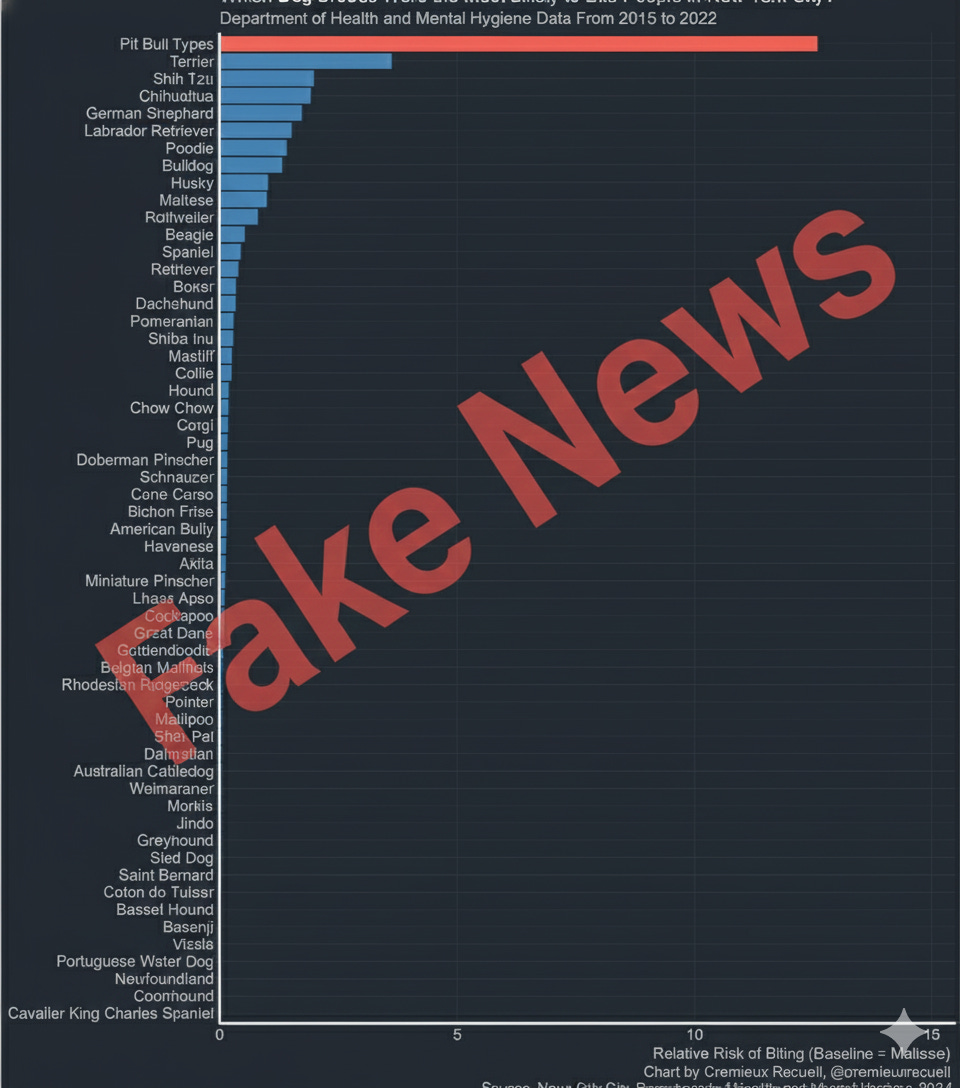
On X, Jordan Lasker, who goes by the internet name “Cremieux,” is attacking dogs alleged to be “Pit Bulls,” even endorsing calls for all of them to be killed. Jordan’s claims are primarily based on his own analysis of bite data from New York, in which he concluded that “Pit Bull Types” in New York City are 12.59 times more likely to bite than Maltese. No such risk exists. This claim has two inputs: the number of bites by breed (the numerator) and the population of that breed (the denominator). Both are systematically biased in ways that inflate the risk. When the flaws are corrected, the risk evaporates.
Data Errors
Data Discrepancy: The chart relies on dog licensing records to estimate each breed’s total population. However, New York City has a licensing compliance rate of only about 20%. In addition to discrimination by private landlords and property managers, residents in public housing (NYCHA), where “Pit Bull Types” are banned, are structurally discouraged from licensing their pets to avoid lease violations. This results in a “deflated denominator,” making the bite rate appear much higher than it is for “Pit Bull Types.”
Visual Misidentification: Bite reports rely on unverified visual identification by victims or witnesses. Studies show that even professionals over-identify dogs as “Pit Bulls” by a factor of 2.5. Bite victims are not trained professionals, so they are likely to be even less accurate at identification. This creates a “wastebasket” effect in the data. The “Pit Bull Types” category in the bite dataset serves as a repository for a vast array of mixed-breed dogs that share broad physical characteristics, such as a blocky head or a short coat. This results in an “inflated numerator,” making the bite rate appear even higher than it is for “Pit Bull Types.”
Aggregation vs. Fragmentation: The “Pit Bull” category aggregates multiple breeds and mixes, while most other breeds are treated as discrete, fragmented categories. The statistical implication is profound: The “Numerator” (bite reports) for “Pit Bull Types” is inflated by false positives (dogs that are not “Pit Bulls” are included), while the “Numerator” for other breeds is artificially deflated (as their mixes are siphoned off into the “Pit Bull” category).
Scientific and Public Safety Errors
Misunderstanding of Risk: Dog bites are rare events, even in a city with hundreds of thousands of dogs. In New York City, the vast majority of dogs labeled “Pit Bull Types” will never bite. Likewise, the vast majority of people will never be bitten by a dog. Only 0.039% of residents are bitten annually, and serious injuries requiring hospitalization occur at a rate of roughly 0.0035% across all breeds.
Behavior vs. Breed: Scientific research indicates that breed is a poor predictor of individual behavior, and “agonistic threshold” (aggression) correlates nearly zero with breed. Not surprisingly, breed-specific bans kill many non-aggressive dogs but fail to reduce dog bites or improve public safety.
For a full analysis of Jordan’s claims and errors, click here.