

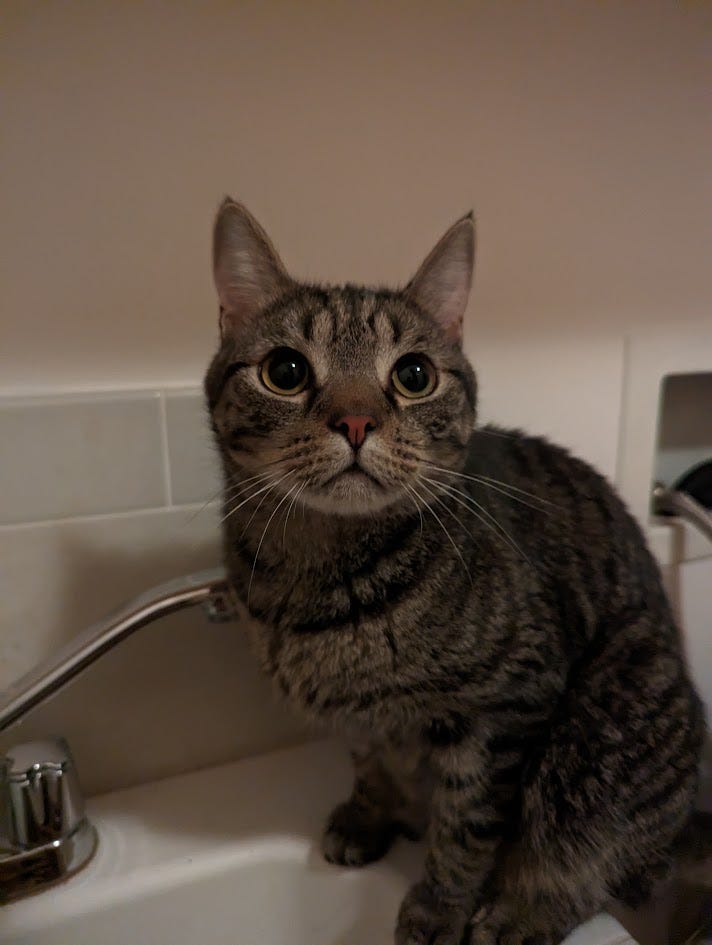
I have a cat named Grimm. He was abandoned in Philadelphia by his former person, who turned him out when her landlord found out she had a cat. My daughter rescued him and brought him to us. Grimm spent the first week or so under the bed, slowly came out, and then discovered the sink. He now has one overriding goal in life: sink water.
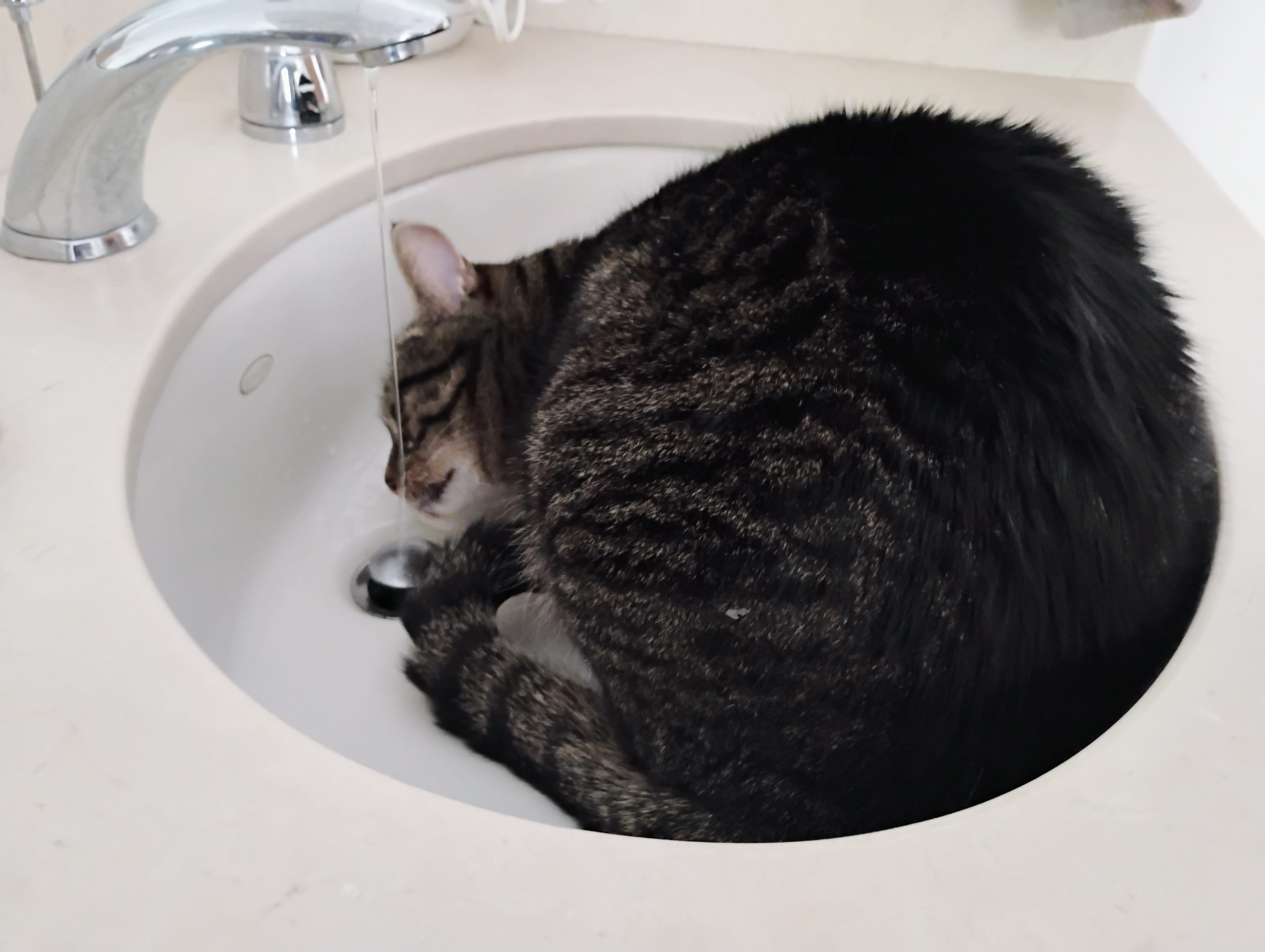
I decided to keep a count of how much water Grimm demanded and how often I obliged. Some people keep a fitness or calorie journal. I kept a tab open on my phone for Grimm’s water requests. The result? In 2025 alone, Grimm asked for water 2,361 times. And yes — I turned on the faucet 2,361 times. (Rescuers, you need not worry. His kidneys are fine; he’s been given a clean bill of health. Grimm is merely a hydration enthusiast, the feline equivalent of a GenZer lugging around an oversized water bottle.)
Like Adam and Chubbles, his brothers, Grimm has a perfectly good water bowl. It’s pretty (gold in the winter and a blue ceramic to keep the water cool in the summer). It is washed daily. The water is always fresh. But to Grimm, this bowl is merely decorative. The only acceptable form of drinking water is running water from the sink.
Morning, noon, night: If he so much as suspects there is a drop of H₂O waiting to run, he will find you. And he will ask. And the sinks must vary. Sometimes he wants kitchen sink water. Sometimes he wants bathroom sink water. Sometimes he wants water from a different bathroom sink. 2,361 times. I am the human embodiment of a water pump.
While tracking Grimm’s faucet requests, I also kept a few other statistics, like the litter box — a duty we all know intimately in the rescue world. In 2025, I scooped the litter box 2,571 times. That’s a lot of scooping.
I realize that an article about 2,361 drinks from the sink and 2,571 scoops of a litter box is somewhat odd. But for those of us who’ve worked in shelters or do rescue, those numbers speak of care and the tiny lives entrusted to us. They tell us to wake up early, go to bed late, and do the work because someone has to. And they remind us that acquiescing to little absurdities is important because animals find comfort in routines. Besides, little things make big memories. Years from now, I might not recall a lot, but I will remember Grimm and his insatiable need to have water cascade off his face and down the drain.
To the people reading this — who spend days filling water bowls, scooping litter, cleaning runs, comforting frightened animals, walking dogs, racing to the emergency vet, advocating for a more compassionate world, and turning bathrooms and spare rooms into rehab facilities — you know the work we do is very serious. We deal with heartbreaking cruelty, neglect, and loss. Yet on any given day, we also witness profound joy: that first purr, the first time the tail comes out from under the dog and wags, the slow build-up of trust from an animal who’s finally safe and no longer ducks his head when you go to pet him, and the bittersweet relief of finding a loving home or release back to the wild. It’s important to take moments like these and let them remind us of why we do what we do.
So to all who open their hearts and homes to animals in need: Happy New Year! Here’s to another year of cleaning messes, offering sips of water, and the steady — drip, drip, drip, scoop, scoop, scoop — rhythm of care.

P.S. Keeping Grimm hydrated, the litter box clean, advocating for humane policies, and nurturing all the animals we rescued and found homes for can take its toll. In 2025, I was fueled by 1,804 shots of espresso, 218 cocktails, 747 kisses from my wife, and one championship ring in my softball league.
Hi Nathan,
Happy New Year.
I Iove your Grimm story.
On Christmas Eve I stopped to help my Dad's neighbor get a grip until her cat could be found. Luckily she bolted back to the door
while I was talking to her before I left...and whatever we did, it helped to get her cat back.
I was calm and she is loud with a very skittish cat, so there is that, being calm and helping her calm down as she was quite distraught.
I said I would do everything in my power to help find her cat and to do prayer if she believed that helps. I do and we did, but
my point is that seeing a need up close and personal like your daughter did with Grimm and her neighbor, I learned much from years ago from you, like rehoming and helping animals is not rocket science. It is a set of learned skills that need to be committed to.
I offered to pay a 500. reward and would have as I could afford it, but I know what commitment looks like and how important it is to helping pets and people.
The idiosyncrasies are immeasurable -- quite comical -- and it all probably makes sense -- you gotta love Cats like Grimm -- thank you for sharing -- thank you to Daughter for bringing him in.