

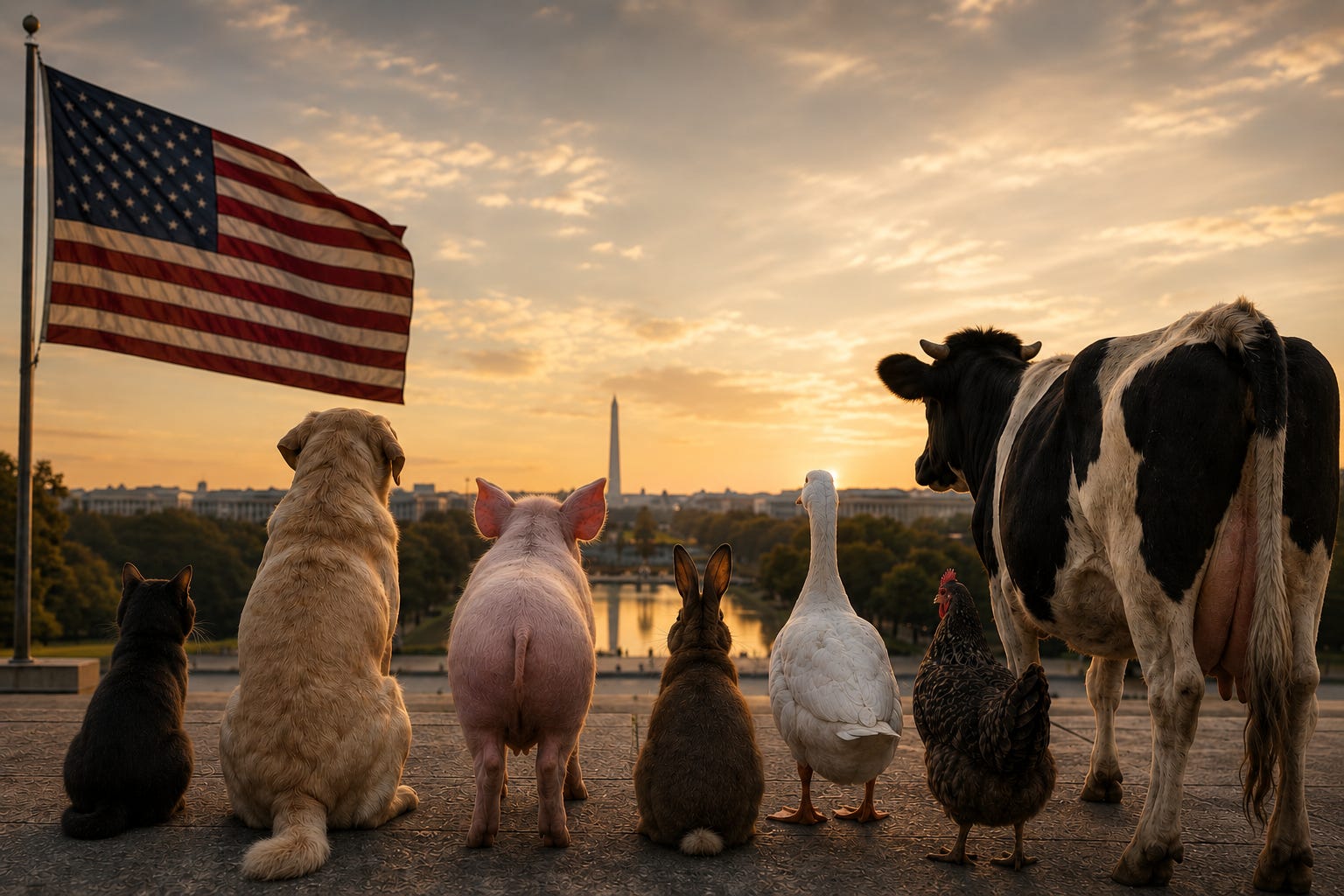
The 4th of July marks the 250th anniversary of the United States Declaration of Independence — a once-in-a-generation milestone commemorating the nation’s founding in 1776. Despite all the cynicism, complaints, and oikophobia of many of my fellow citizens, and while America remains — and will admittedly always remain — a work in progress caught between promise and practice, it continues to be the beacon of hope that outshines all the rest. More than that, it remains the country most likely to lead the way in liberating animals from oppression. Why? Because no other nation comes close to hitting the Goldilocks zone of capitalism, democracy, limited government, innovation, free expression, and Enlightenment values.
Of all the world’s market economies, capitalism — with its relentless pursuit of innovation — promotes alternative technologies in ways that other economic and political systems like communism do not. And of all the market economies, America’s balance of regulation and market freedom keeps the nation at the forefront of technological innovation, and with it, moral advancement.
Capitalism is frequently criticized for driving mindless consumerism at the expense of deeper values. But such a view overlooks a more profound truth: capitalism often creates values by creating alternatives.
Every economic system depends on consumerism. That is how people in societies of 340 million (in the case of the U.S.) or 1.4 billion (in the case of China and India) acquire the resources needed to survive: food, clothes, housing, and transportation.
In a free-market democracy, an entrepreneur who creates a superior alternative to products or services that harm animals — whether a clay pigeon instead of live birds for shooting, a cable car instead of working horses, or a plant-based or cultivated replacement for an animal product — can fundamentally alter society’s moral calculus. As humane alternatives become cheaper, more effective, more widely available, and in the case of food, more delicious, practices once deemed inevitable become unnecessary, and eventually, indefensible. Innovation changes culture.
In a communist society, that may not be possible. For example, China’s animal “medicine” industry — factory farming animals so that their tissues, organs, and secretions can be used for Chinese “medicine” — is a close second to factory farming animals for food in terms of sheer brutality. This includes harvesting bear bile in some of the cruelest conditions imaginable, drinking goose and chicken blood from live animals, and skinning deer and donkeys alive (ostensibly to improve the medicinal quality). But unlike raising animals for food, it is brutality for brutality’s sake because the “medicines” don’t work and are not intended to.
They are a jobs program created and promoted as “miracle cures” under Chairman Mao Zedong to keep people in communist bondage. To this day, the industry provides jobs for unskilled laborers in so-called “prestige” careers in “medicine.”
Consequently, despite synthetic versions of bear bile, these are not being adopted because bear bile and other animal-based “medicines” are claimed to be “ancient wisdom” and “traditional” Chinese cultural practices rather than Western imports (though they are neither ancient nor Chinese, having been imported from the equally backward Soviet Union). Under communism, criticizing Chinese “medicine” is criticizing the authoritarian state itself.
Regardless of whether one is concerned with human rights, animal welfare, or both, communism’s historical record is one of repression and abject failure. The only people who still take it seriously are those who are anything but: naive young people ignorant of history, and academics more captivated by abstract theories than real-world atrocities or seeking to make a name for themselves at the expense of the truth.
In addition to capitalism and democracy, promoting human and animal flourishing requires the embrace of Enlightenment values, starting with the immortal phrase of the Declaration: that we are entitled to the unalienable rights to life, liberty and the pursuit of happiness. While the revolutionary war those words sparked may be over, the battles for liberation they inspired are not. The last two and a half centuries have witnessed one disenfranchised group after another build on their foundation to win equal rights and equal protection under the law.
By exposing the hypocrisy that one group’s rights were regarded as “self-evident,” while others were not acknowledged at all, abolitionists, suffragists, civil rights activists, and disabled rights advocates have all invoked the Declaration of Independence and the eternal principles it espouses in their own quest to realize its promises and help us to form a more perfect union.
And yet there are still billions of beings who do not yet have the rights we demand and accept as “unalienable” for ourselves. There are still billions of beings who — though they may differ from us in some ways — share the things which, as the Declaration proclaims, are the things that matter most: the desire to live, to be free, and to be happy. In these significant ways, humans and non-human animals are identical. Aren’t they entitled to life, liberty, and the pursuit of happiness? Yes, they are.
Of course, no country has lived up perfectly to its ideals, and America certainly has not. But if there is any nation where the promise of freedom and happiness rings possible, it is the United States of America. Its core values continue to challenge each successive generation to expand the circle of moral and legal concern. The very tools used so successfully by prior movements — our free speech, our civil liberties, the equal application of justice and rule of law, and the very American belief that a better tomorrow is both desirable and possible — can be used for the benefit of animals. In short, the same principles that once fueled abolition, suffrage, and civil rights can — and will — fuel the next great movement to free animals from oppression.
On this 250th anniversary of the Declaration of Independence, there is much worth celebrating — not only because of the great abundance and freedoms we enjoy in America, but because its founding tenets give us the tools to do even more, for more.
Beautifully nuanced view. Thank you and happy 4th to all the creatures of the world. May a better tomorrow be at hand.
Thank you for your courage to always share the truth about our precious animals.