

As occurs every year, a bill to outlaw bestiality was introduced in West Virginia. West Virginia is the only state that does not explicitly criminalize the sexual abuse of animals.
The law failed to pass in past years, often failing to get a hearing, because opponents claimed it was already illegal under the more general animal cruelty statute. But that may not be entirely accurate. According to the legislative sponsor,
“I’ve been putting this bill forward, and now this amendment forward, for several years. I get a call from Charleston Police probably once every couple of months about prosecutors that drop these cases. Recently I saw a policeman and he stopped me and begged me to introduce the bill again. So I saw an opportunity to do it in this bill, and yes, we would be the 50th state that would ban this explicitly in code.”
Given that explicitly banning it would resolve any ambiguity, its failure to pass remained inexplicable. This year appeared to be different because it passed the House by a vote of 93-1. Unfortunately, in a profound failure of decency, it died in a Senate committee, and the West Virginia legislature adjourned for the year.
The bill was especially important as a growing number of academics are promoting the sexual abuse of animals. For example, Peter Singer, the Princeton professor, world-renowned philosopher, and author of the book “Animal Liberation,” promoted an article that claims it is “morally permissible” to rape animals. Of course, Singer doesn’t call it rape, and he doesn’t believe it is rape. But in “Zoophilia is Morally Permissible,” an article he edited and published in his Journal of Controversial Ideas, the article’s author, who uses a pseudonym to hide his identity, laments that:
Zoophilia is one of the few sexual orientations (along with e.g. necrophilia or pedophilia) that remain offlimits and have been left aside from the sexual liberation movement in the past fifty years. I would like to argue that this is a mistake. There is in fact nothing wrong with having sex with animals.
Singer is not the first professor to make these arguments. Others have made similar claims, including a Duke University professor, a North Dakota State professor, and a Kansas State University professor. They are wrong, revoltingly so.
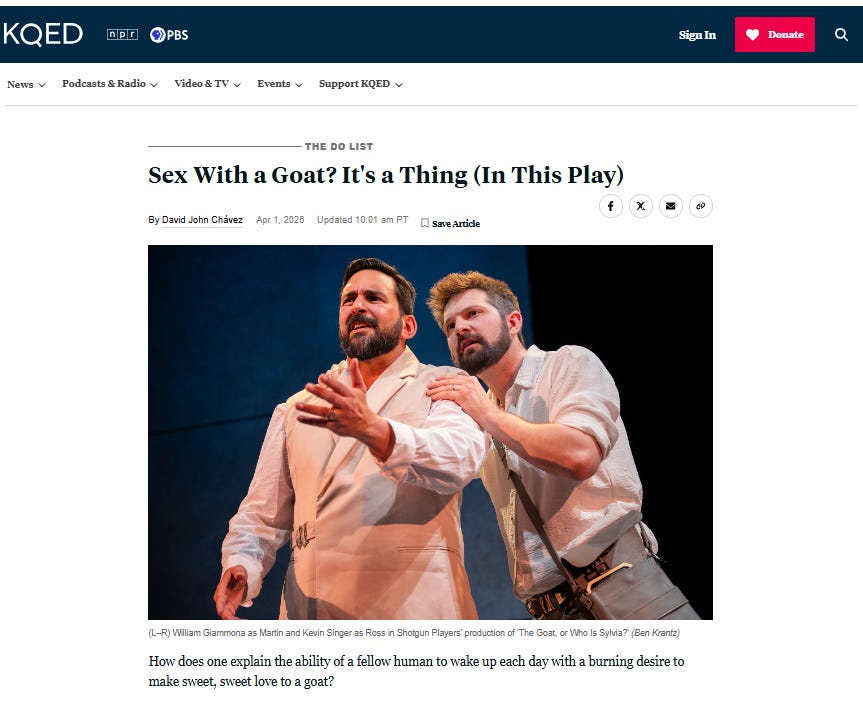
And just this week, KQED, a local PBS station, lauded a new play “about bestiality, and a human finding carnal connection with an animal that, while displaying human characteristics, has no capacity for greater yearning. But that’s not all the play is trying to convey. Ultimately, The Goat is about societal taboos, many of them centered on human sexuality — but who determines those, where is the line, and who has the right to draw that line?”
We do.
We draw it at consent (which children and animals cannot do). We draw it at the age of human adulthood. We draw it to prevent rape. We elect legislators to pass laws to punish those who violate these (which West Virginia senators grotesquely failed to do).
Billions of people around the world — the vast majority of our planet — do not sexually assault animals. They do not ever contemplate rape or sexual battery because it would never occur to them to do so. According to Singer, upwards of 98% of people do not suffer from this pathology (I suspect it is higher). The extreme minority that does is neither entitled to its normalization nor to exploit vulnerable populations to express it. What these people need is medical and psychological intervention and, when they break laws by engaging in it, incarceration to protect further victims.
In short, humans having sex with animals — like sexual assault of children — is rape. Like children, they suffer trauma, with chickens and other small animals often killed in the process. But even without physical trauma, it is a line that should never be crossed and never be treated as anything other than what it already is in 49 states: a crime.
Shame on West Virginia.
Once again, thanks for championing causes to help animals.
"It died in a Senate committee, and the West Virginia legislature adjourned for the year."
Do you have the names and government addresses and office phone numbers of the members of the committee that allowed this bill to fail? Otherwise I can try to find them. They shouldn't seek re-election again ever. There is a big world outside the small world of this committee and my guess too is not many in West Virginia know this.