

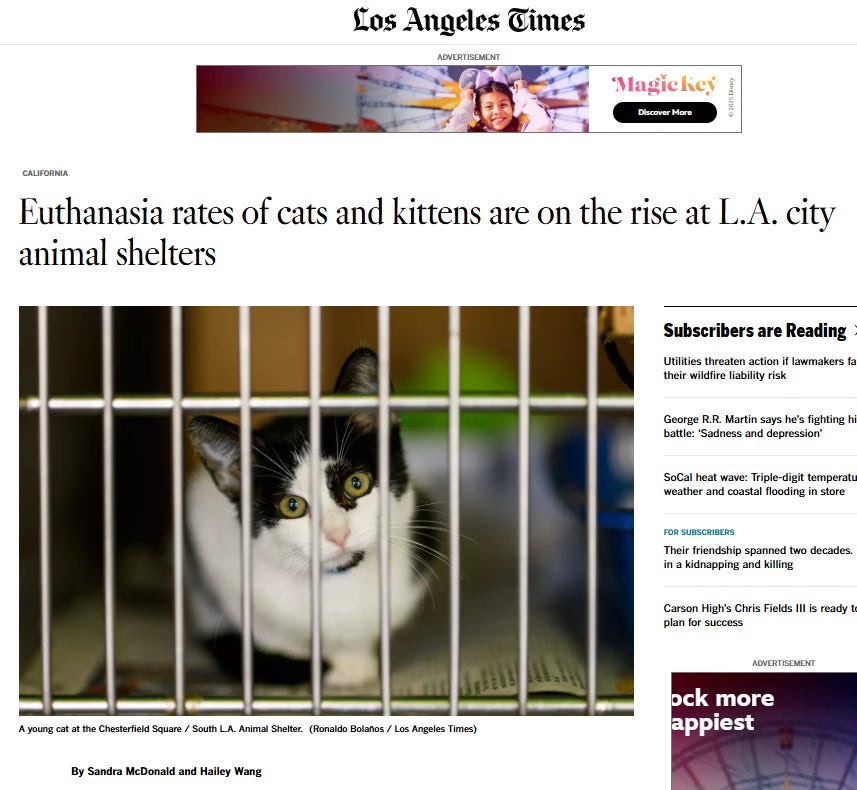
The Los Angeles Times did a report on the harrowing spike in killing of animals at Los Angeles Animal Services (LAAS). And it is harrowing: cat killing is up a staggering 32% year-to-date compared to last year, kitten killing has increased even more, and even dog killing is up. Unfortunately, the piece was written by two young reporters, both fresh from being interns, and it shows. Even though one of those interns describes herself as “passionate about uncovering hidden narratives in data sets,” she and her colleague utterly failed to find that narrative. Maybe that’s because it wasn’t hidden: it was in plain sight for all to see.
Interviewing the usual list of suspects — including PETA, an organization that has a long sordid history of lying and stealing animals to kill and has killed over 50,000 dogs and cats, including healthy puppies and kittens — they settled on the usual culprits: too many animals, not enough spay/neuter.
Of course, more sterilization is always better when pounds like the one in Los Angeles are staffed by people only there for a paycheck and committed to doing as little as possible. The lower the intake rate, the fewer the number of potential victims. But as the numbers clearly show, even a decline in intakes doesn’t necessarily equate with less killing.
Dog intakes have declined by 13% compared to pre-pandemic levels (2025 vs. 2018), but dog killing is up roughly 30% in that same period. Comparing year-to-date dog intakes and killings with the same period last year, dog intake declined 6%, but pound staff killed 2% more dogs. And it isn’t just dogs. Kitten intake actually went down by 14% compared to pre-pandemic levels, but killing increased 40%.
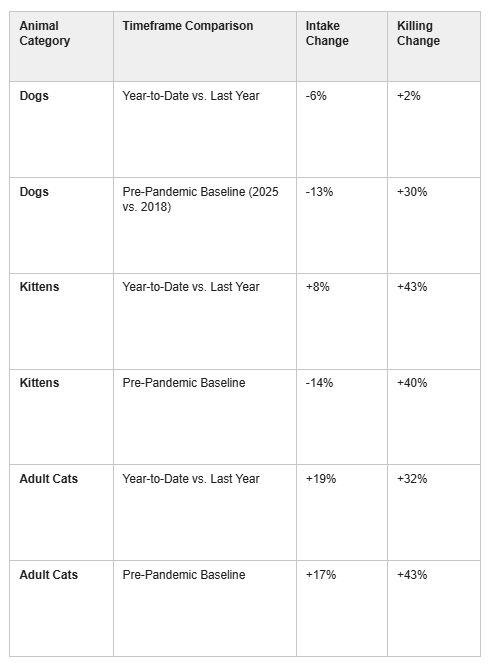
In short, it doesn’t matter if intakes go up or down at a regressive pound like LAAS, killing will still go up. That’s not really a hidden narrative. It’s math.
And even though adult cat intakes did increase, the numbers still do not add up: intake increased 17% compared to pre-pandemic levels, but killing did not proportionally increase — it skyrocketed by 43%. And while kitten intake did increase by 8% year-to-date compared to last year, the pound killed a whopping 43% more kittens in the same time period.
Why the disproportionate increase in killing? Let’s uncover the “hidden” narratives in the dataset that the cub reporters failed to.
Reduced opportunities for adoption
First, I would look at the choices made by city officials. I’d start with the fact that adoption hours have been cut back from pre-pandemic levels. The “shelters” are no longer open for adoption until 7 pm on Tuesdays and Thursdays to make it easier for working families to adopt and foster.
Neglect, abuse, and corruption
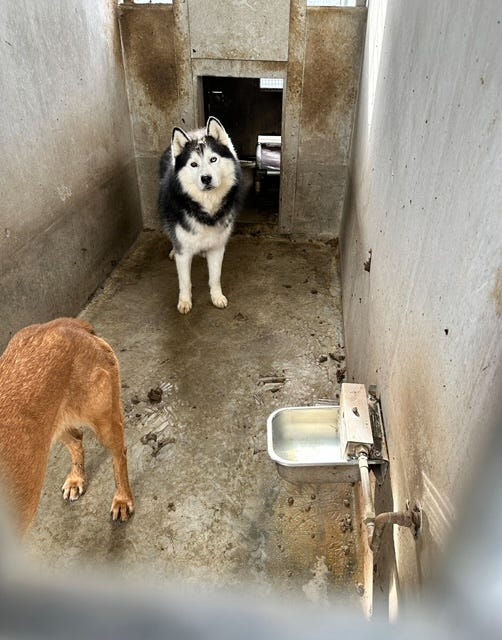
Second, I’d also consider that LAAS has long been, and continues to be, an agency rife with neglect, abuse, and corruption. In addition to an increase in killings, dogs spend weeks or months inside their filthy kennels without a walk, often without clean water and soft beds to lie on. As a result, they experience increased stress, giving LAAS an excuse to kill the dogs as “unadoptable” even though they are healthy and of good temperament outside their kennels.
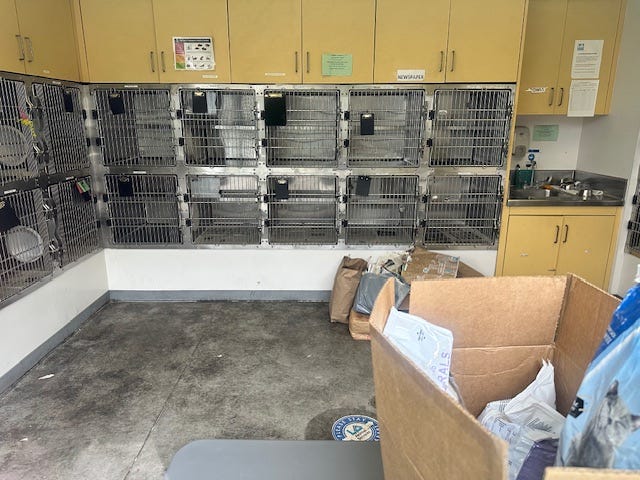
In addition, cat rooms are mostly empty and, in some cases, entirely empty, while staff at the pound either kill them or turn cats away, leading to mass abandonment. Across the street from one of the “shelters,” volunteers are forced to care for many of those abandoned cats.

Prior reports also uncovered rabbits with gouged eyes, guinea pigs without food, and hamsters in cages soaked in urine and feces. And when an employee admitted to striking dogs, the volunteer who exposed him was punished, not the abuser.
Elected officials indifferent to constituent concerns

Third, I would look at the Governor, state legislature, the mayor, and city council. This isn’t a partisan attack. It is an attack on one-party rule (i.e., supermajorities), regardless of whether they are on the Left or the Right. As most Americans no longer live in contested districts, elections matter less and, in thoroughly single-party districts, almost not at all.
As such, there is no incentive for elected officials to solve problems occurring under their watch, and no ability for constituents to force them to do so. Instead, ideology and tribal affiliation rule the day, making it challenging to hold any agency — let alone one that deals with “lowly” animals — accountable. And given that the only threat comes from within the elected official’s own party — being primaried by someone on the Left if a Democrat or on the Right if a Republican — going along with the ideological program protects them.
A CalMatters Digital Democracy analysis of voting records found that, on average, legislators broke from their party position less than 1% of the time. In other words, 99% of the time, elected legislators voted in lock-step, doing what they were told by the party, even when a majority of constituents wanted otherwise. The only legislators willing to stray from the herd, buck their party, and do what their constituents wanted were those representing the few competitive swing districts left in California.
Before California became a supermajority state, bipartisan competition allowed passage of legislation making it illegal for pound staff to kill animals when rescue groups were willing to save them. Shelter reformers were able to significantly increase holding periods, add a holding period for owner-surrendered animals, and require prompt and necessary veterinary care despite the opposition of every “shelter” in the state, saving millions of animals in the process. Legislators were sensitive to constituent concerns and therefore focused on enacting good policy, regardless of ideology, to avoid being voted out.
With Democrats now holding veto-proof supermajorities in both the Senate and the Assembly, and controlling the governorship, every statewide executive office, both U.S. Senate seats, a large majority of the state’s U.S. House delegation, and in Los Angeles, the mayor’s office and every elected office of note, such reform would have no chance of passage today. This isn’t speculation. The No Kill Advocacy Center has tried repeatedly.
Every legislative effort to reform pounds ends up getting killed by the Democratic establishment at the behest of pound managers. Had California successfully passed Bowie’s Law in 2023 requiring LAAS and other pounds to give rescuers 72 hours notice before killing animals, for example, the numbers in Los Angeles would look a lot different.
On this last score, I don’t expect change anytime soon because partisanship appears more important to primary voters than electing officials who will solve problems and ensure responsive government — including reforming dysfunctional, abusive, kill-oriented “shelters.” That means continued incompetence, apathy, corruption, and killing at LAAS. And that is as plain to see as the math.
Superficial reporting
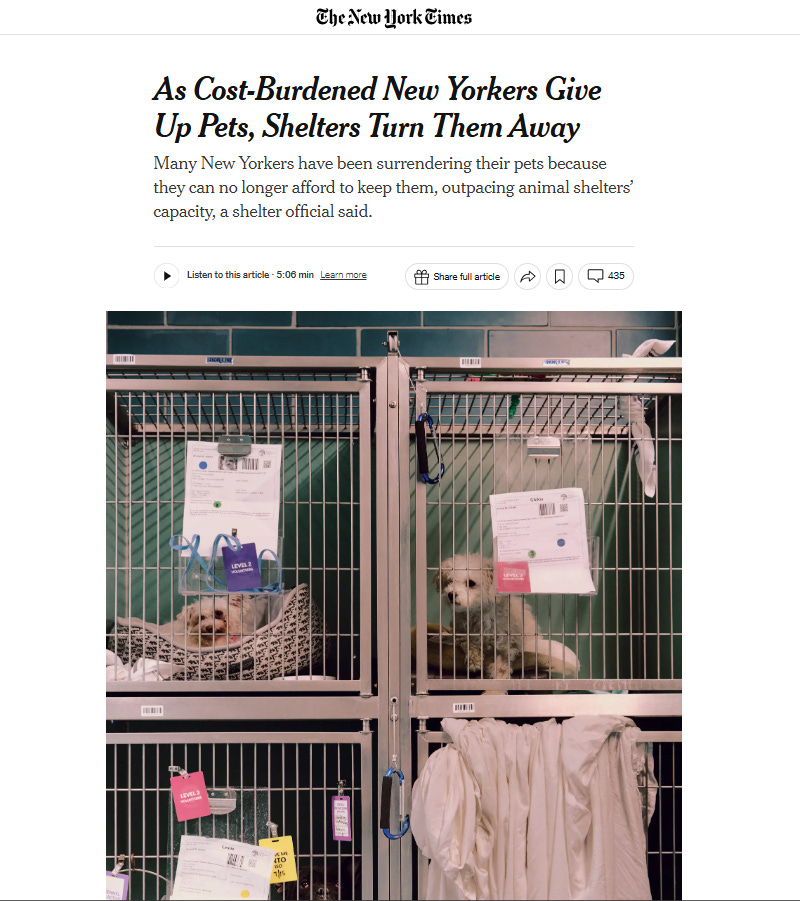
Finally, I would look to the Fourth Estate. Instead of obfuscation on behalf of special interests by regurgitating PETA’s apologia about the need to kill without more spay/neuter, the Times should have reported the truth in order to hold city (and state officials), including pound managers, to account. Unfortunately, they are not alone in their dereliction of duty.
A reporter at the New York Times wrote a similar superficial piece last year about the rise in killing despite declines in intakes at the pound in that city. Regrettably, what I wrote about New York then applies to Los Angeles now: Aside from an epic failure of journalism to accurately report on this topic,1 the Times piece allows leadership and staff at the regressive and abusive pound to continue avoiding accountability for their own mismanagement. And that comes with a body count.
Like their analysis of pound killing, newspaper publishers like those in New York and Los Angeles lamenting the loss of readers by blaming everyone and everything but themselves must look within. If they want more people to read their articles, to once again trust them as a source for investigative truth, they need to get back to writing articles that illuminate, rather than obscure. In short, they need to write articles actually worth reading.
Dear Nathan, Your smart legal and analytical skills qualify you to be the next Governor or Attorney General of California. It is a shame that the current administration of Governor Newsom and LA Mayor Karen Bass do nothing to protect the voiceless animals that suffer the consequences of the ignorant and incompetent and insensitive managers of LAAS. And your brilliant detection of the inaccurate reporting of the newspaper reporters qualifies you to take charge of the newspapers. Your exposure of the shocking 50,000 animals killed by the hypocritical PETA makes one wonder how they can use the word “Ethical “ in their name. Most importantly, it is so sad that the people who manage the pounds/“shelters” in Los Angeles continue to get away with the torture and murder of so many lovable dogs and cats and other animals who cannot speak up for themselves. As l have stated many times in the past, it would seem that their upbringing did nothing to educate them about the unconditional love that dogs and other animals can give them in order to make them more compassionate human beings. That is why I repeat my emphasis on the need to develop more Animal Study Programs and Schools where children can interact with dogs and other animals in order to develop an awareness of how Animals as Sentient Beings can teach them kindness, love, and compassion. Thus, both current and future generations will positively change how shelters will be managed, I.e., by more humane and compassionate people who will embrace the principles of Nathan Winograd’s No Kill Advocacy Center and the recognition that EACH And EVERY LIFE MATTERS.❤️🐶😸🐇🙏
Really excellent but heartbreaking article. I have no words for the ongoing "shelter" travesty.