

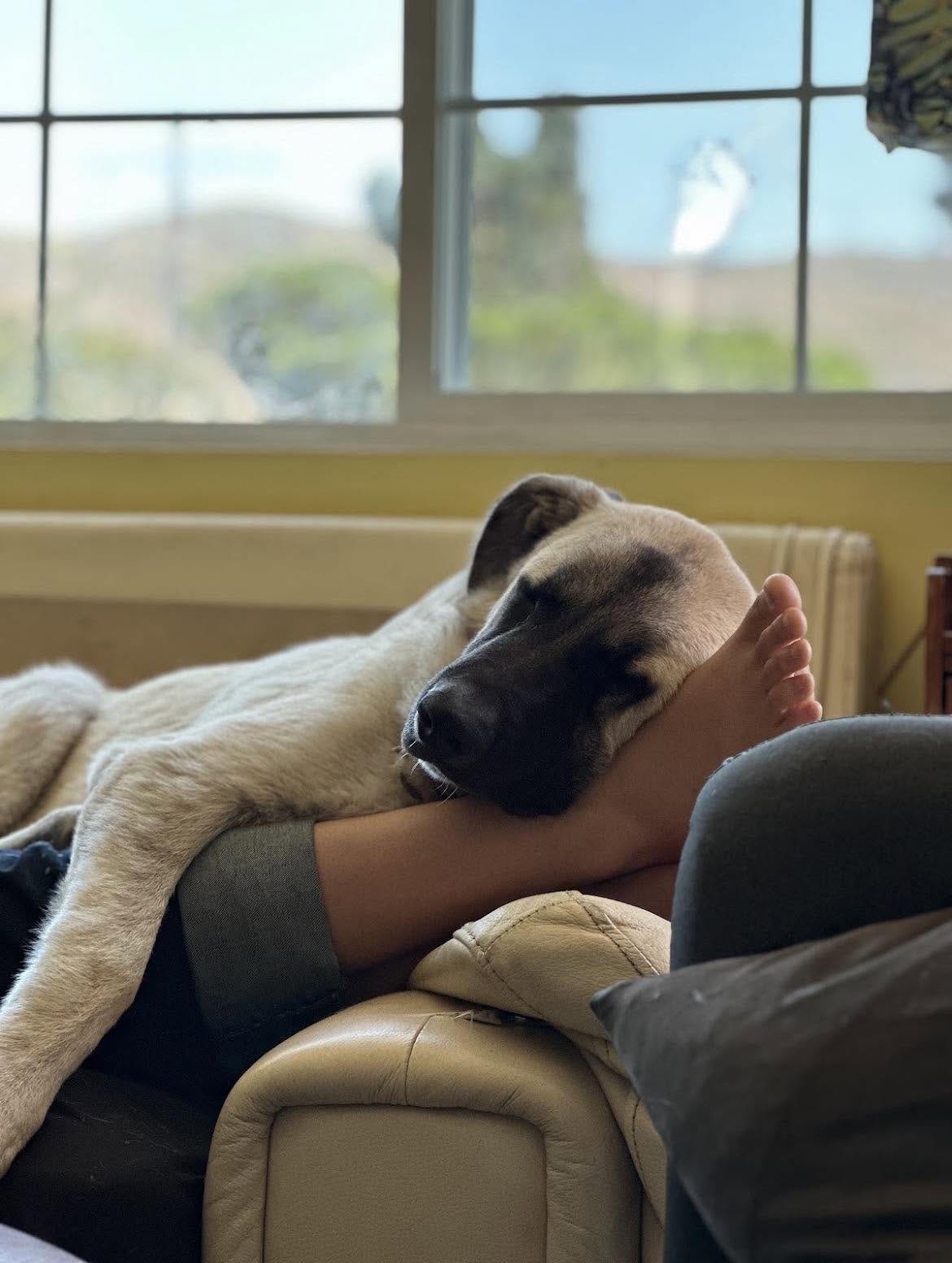
As previously reported, Ventura County Animal Services (VCAS) is being sued to prevent it from killing Bruce, a dog ordered destroyed after being declared “vicious.” The lawsuit was filed by the Santa Paula Animal Rescue Center (SPARC), which argues that it retained contractual rights to Bruce under the adoption agreement executed when the dog was adopted in 2023.
According to SPARC, ownership reverted to the rescue organization after Bruce’s adopters became homeless, Bruce began acting out aggressively, and they relinquished him to VCAS. SPARC contends it was never notified of the proceedings that resulted in the destruction order and was denied an opportunity to assert its contractual and property rights before the County ordered Bruce killed.
The litigation also challenges the factual basis for killing Bruce. Although the County relied on prior incidents to classify him as dangerous, records from Bruce’s months in the shelter describe him as a “model citizen” who behaves well with kennel staff and adapts successfully to a stable, controlled environment.
As a compromise, SPARC has offered to send Bruce to a sanctuary, where he can live out his life without threatening the safety of the public. VCAS has rejected the offer.
When I was a criminal prosecutor — a “Deputy District Attorney” by title — I served the people of the state of California. I did not narrowly serve the elected District Attorney, police departments, their officers, or even crime victims. I served all of them and more. When I walked into court, I introduced myself as “Nathan Winograd, for the People.”
In evaluating cases, making charging decisions, offering plea bargains, taking a case to trial, or making sentencing requests, I never sought to “win” regardless of the consequences because my job was to consider all the interests at stake, including those of the perpetrator, whose constitutional rights I was also there to protect and serve. It was a responsibility I took seriously.
In one particular trial I was likely to win easily, I was bothered by one aspect of it. I sent an investigator to look at the crime scene, asked for a short delay, did additional research, concluded that the statute and the nature of the facts were capable of two interpretations, and ended up dismissing the case in the interest of justice. Winning for the sake of winning was a loss for my integrity, for the constitutional rights of the accused, and for the people.
This is not a divorced-from-reality defund the police/restorative justice fever dream. I believe in enforcement of the law. I handled three strikes cases, death penalty cases, animal cruelty cases, domestic violence cases, and child sexual assault cases. When a defendant poured gasoline and lit his neighbor’s cat on fire, in addition to charging him with cruelty, I charged him with arson of property under the three strikes laws. When a different perpetrator strangled his dog with guitar string, I added a use of deadly weapon enhancement that guaranteed prison time. But, as I said, I took my job and my role as a representative of the people and through them, the cause of justice, seriously.
Ventura County’s animal “shelter” director and the assistant county counsel handling Bruce’s case are not serious people.
VCAS director Esteban Rodriguez and Christine Renshaw, the Assistant County Counsel representing him, want to win at all costs, regardless of the irreversible, manifest injustice that would occur if they do. At least that is the way it looks from here. If they prevail, Bruce, a dog VCAS describes as a “model citizen” will be killed, even though he can safely spend the rest of his life in a controlled environment. Instead of accepting that outcome in the interest of justice, Rodriguez and Renshaw appear hellbent on turning Bruce into ash.
They are monomaniacally focusing on proving to a judge that the agency followed its own procedures and had the legal leeway to make that decision, viewing any outside challenge — even from a sanctuary willing to spare Bruce’s life — as an attempt to undermine their legitimate government authority. Indeed, they have threatened to ask for sanctions in the state court lawsuit on Bruce’s would-be rescuers for seeking their day in court. It smacks of retaliation, which Rodriguez has been accused of before and which, it appears at least in part, led to his departure from running the Seattle pound before he was hired by Ventura County. (In resigning, Rodriguez called the claims of retaliation a “complete fabrication.”)
In federal court, VCAS is seeking to dismiss the case on jurisdictional grounds, based on the Rooker-Feldman doctrine. Rooker-Feldman bars federal district courts from being used as appeal courts to overturn state court judgments. SPARC argues it doesn’t apply because they were never named, served, joined, or heard during the state court proceedings and an entity that was not a party to a state case cannot be barred from suing in federal court. Additionally, SPARC is not challenging the state court’s ruling. It is suing for a deprivation of property without due process of law, a federal civil rights action because VCAS took custody of Bruce, failed to notify them, and omitted them from court filings and proceedings.
If you did not quite grasp the last paragraph, that’s the point. Instead of asking whether Rooker-Feldman applies, Ventura County should be considering whether there is a kind, common-sense alternative that can achieve the stated ends — protecting public safety — while also giving Bruce an opportunity for life and happiness.
There is: sending him to a sanctuary.
As SPARC’s attorney writes in a letter to Crenshaw,
[M]ultiple efforts were made to resolve this case without killing Bruce. Santa Paula Animal Rescue Center was the first option presented and has remained available throughout. Mr. Rodriguez rejected it. Dogtown Ranch was discussed as another placement for Bruce. Mr. Rodriguez rejected it. West Coast Cane Corso was another option. Mr. Rodriguez rejected it. SPARC remains willing to fund Bruce’s placement with any qualified rescue sanctuary, but Mr. Rodriguez has rejected every lifesaving proposal.
This makes no sense. VCAS has sent other problematic dogs to SPARC without incident, including dogs “exhibiting ‘severe aggression,’” who “could not be safely handled” and had “a poor prognosis” for successful rehabilitation. According to VCAS, one of those dogs “growled, showed his teeth, repeatedly bit and chewed the slip lead, and required a catch pole.”
By contrast, Bruce can be hand-fed treats. He also “has a substantially better in-custody record, with no documented bite, attempted bite, charge, lunge, snap, or aggressive handling incident.” As Dan Bolton, SPARC’s attorney documents,
On February 23, Bruce was easy to leash and walk to intake, permitted all handling and vaccinations without issue, and allowed staff to remove his leash and muzzle without issue.
On March 4, VCAS called him “a model citizen in his kennel” and said he had shown no fear, anxiety, or stress [FAS].
On March 5, VCAS again said that he had not shown signs of fear, anxiety, or stress that concerned the Animal Care team.
From March 11 through April 15, VCAS repeatedly documented low FAS, quiet or resting behavior, no pacing, soft ears and lips, relaxation, treat-taking, tail wagging, and ordinary responses to staff.
On March 22, a staff member sat near him and spoke gently, and Bruce did not react negatively.
On March 28, Bruce lay on the floor and wagged his tail while staff spoke to and engaged him.
On April 4, he approached the kennel gate with a wagging tail and lay down.
On April 26, he was calm and lying down and then lay comfortably during a separate timed observation.
On April 29, VCAS moved him from kennel 144 to kennel 122. No difficulty, resistance, handling concern, or behavioral incident was recorded…
On July 1, he was chewing a treat in his kennel.
On July 5, he was resting against the outer kennel grate, got up, moved into the shade, and lay back down.
On July 13, he was resting when the veterinarian approached within approximately six inches. He rose and walked briefly in response to kissing noises and then lay back down.
On July 16, he moved between kennel compartments during the examination and gave a nervous yawn, but then lay calmly with his head on his paws. No growling, snapping, lunging, or attempted bite was recorded.
On July 20, he rose, stretched, walked briefly toward the veterinarian, and then went inside and settled with his head resting on his paw.
Contrary to Rodriguez and Crenshaw’s belief that sparing Bruce’s life would undermine the legitimate government authority of VCAS, it would solidify it. Because killing Bruce in the face of his “model citizen” behavior and a sanctuary option is not a show of “legitimate government authority.” It is an abuse of power.
It is so IRRATIONAL -- with all life-affirming options available for Bruce, for VCAS to choose death -- not only is it irrational, it's cruel and hateful -- moreover, arguments are all "technicalities" -- NO substance --- it's as if they're deciding the fate of a box of shoes -- What can we do to force VCAS to NOT KILL Bruce.
Dear Nathan, What has happened to Decency, Common Sense, Kindness, and Compassion in this absolutely absurd attitude and behavior of Rodriguez and Crenshaw of VCAS?! I would equate their fixation on wanting to kill innocent Bruce with the behavior and attitude of Hitler and the Nazis in their fixation on killing all Jews . It is as if these “Nazis “ ( Rodriguez and Crenshaw) see Bruce is a Jewish dog. They are evil and insensitive and INHUMANE “human beings “ who have zero compassion for Sentient Beings such as Bruce. They should be brought up on charges comparable to those faced by Hitler’s henchmen in the famous trials following their atrocities. Nathan, as you explain your compassionate attitude toward those on trial when you were a prosecutor, such should be the case in order to save the life of Bruce. Humanity and Common Sense must prevail = Bruce's life matters far more than ignorance and stubborn behavior by VCAS and Rodriguez and Crenshaw. Let us pray that Bruce will live.❤️🐶🙏